4 Times Sea Animals Shielded Humans From Sharks

You've seen the headline before: dolphin saves swimmer. It feels like proof that the ocean has a conscience.
Here's the part that never makes the headline. The same instinct that lifts a drowning human to the surface has also been documented lifting dead calves, sea turtles, and floating planks — sometimes for days. Marine biologists have a cold name for it: epimeletic behavior. Care-giving. Not rescue.
Which turns "do dolphins save people?" into a much stranger question.
What do they think we are?
I've been reading these four cases for years, and my honest position is that they're all real, all documented — and that the popular explanation for them is almost certainly wrong. Here's each one, and where I think the story falls apart.
1. The Swimmer, the Shark, and the Wall
In October 2014, British long-distance swimmer Adam Walker was crossing New Zealand's Cook Strait — one of the hardest open-water swims on Earth — as part of his Oceans Seven challenge.
Partway across, he looked down and saw a great white shark in the water beneath him.
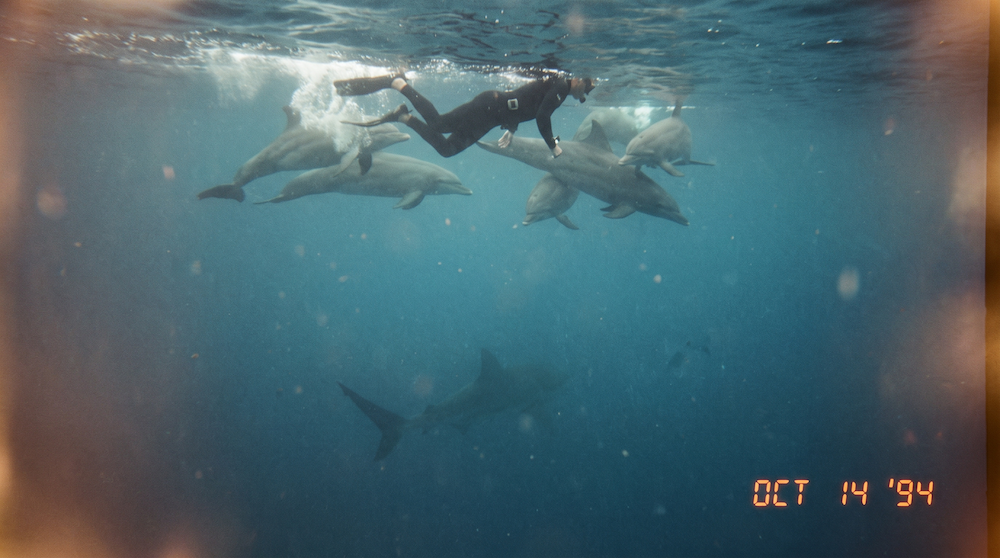
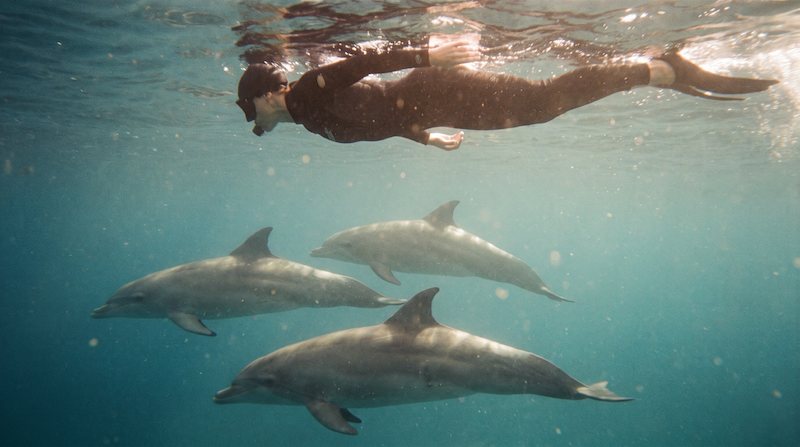
A pod of roughly ten bottlenose dolphins then arrived and stayed with him for about an hour, holding formation until the shark moved off. His support boat filmed it.
Walker has said he believes they were protecting him. My read: the footage proves the dolphins were there and the shark left. It can't prove those two facts are connected. But ten dolphins voluntarily parked in the exact spot where a great white was hunting is not nothing.
2. The Surfer Who Was Bitten Three Times
August 28, 2007. Marina State Beach, Monterey Bay, California.
Surfer Todd Endris was hit by a great white estimated at 12 to 15 feet. It struck three times. The third strike stripped the skin off his back.
A pod of bottlenose dolphins then formed a ring around him in the water. Endris caught a wave in, and a friend improvised a tourniquet on the sand.
He lived. He was back on a board within weeks.
This is the case I find hardest to argue with. He was bleeding heavily — the exact condition that should have kept the shark committed. Something interrupted it.
3. Forty Minutes They Couldn't Leave
October 2004. Ocean Beach, near Whangarei, New Zealand.
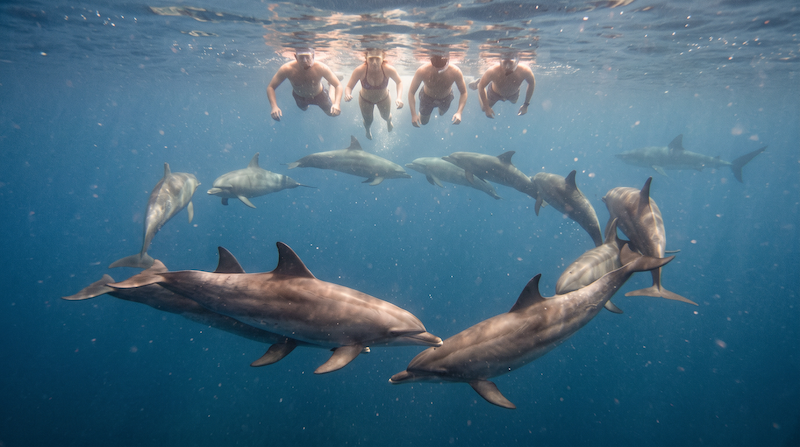
Lifeguard Rob Howes was on a training swim about 100 metres out with three teenage girls, one of them his daughter. Bottlenose dolphins surrounded them and pulled in tight, herding all four into a compact group.
Howes tried to break away. A large dolphin drove him back in.
The circle held for around 40 minutes.
It only made sense when another lifeguard in a rescue boat spotted what was cruising outside it: a great white, roughly three metres long.
4. The Whale That Wouldn't Let Her Go
October 2017. Rarotonga, Cook Islands.
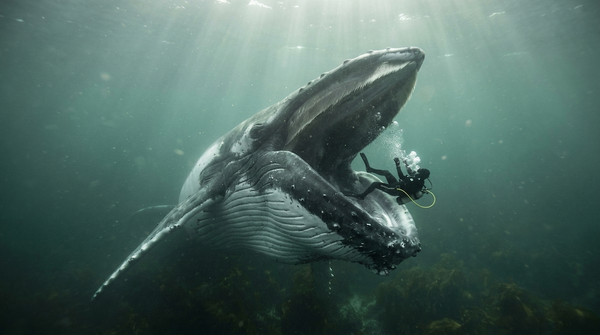
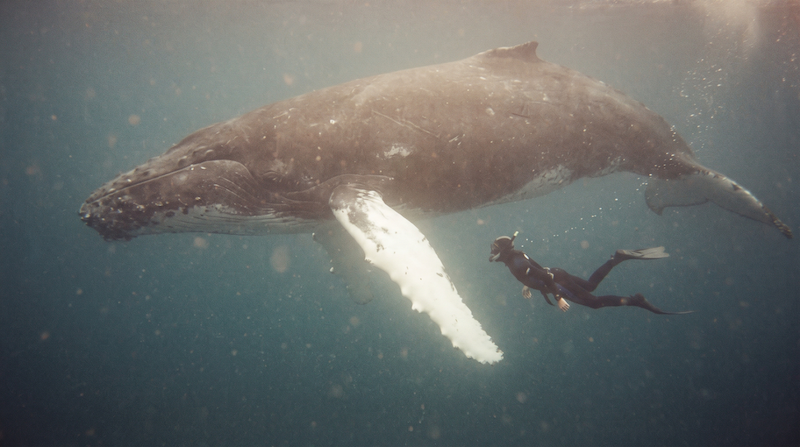
Marine biologist Nan Hauser — nearly thirty years of whale research behind her — was in the water when a humpback whale, roughly 50,000 pounds, started pushing her with its head and tucking her under its pectoral fin, shoving her toward the surface.
She was more frightened of the whale than anything else. Then she saw the tiger shark nearby.
The encounter ran about 10 minutes and was filmed. Hauser believes she was being shielded. Other scientists disagree, arguing an animal that size simply cannot judge its own force around a human.
I lean toward the skeptics here — but I'd note that the skeptics' version still ends with her alive and the shark gone.
The Part That Changes Everything
Here's the research that reframed all four of these for me.
Humpbacks routinely interfere with killer whale attacks. A study led by NOAA's Robert Pitman compiled 115 documented interactions between humpbacks and hunting orcas. Where the prey could be identified, roughly 89% of the time the orcas were attacking something other than a humpback.
Seals. Sea lions. Gray whale calves. Even ocean sunfish.
So humpbacks were charging into fights that had nothing to do with them, for animals they have no relationship with. Researchers call it mobbing — a hardwired anti-predator response triggered by the sound of killer whales, firing regardless of who's on the menu.
Which means:
- The rescue is likely a side effect, not a decision
- We probably fall inside a category they already defend
- A reflex that saves you is still a reflex that saved you
That last line is the one I keep coming back to. People treat "it was only instinct" as if it deflates the story. I think it does the opposite. A deliberate rescue would be a choice one animal made. An instinct means the behavior is built in — that it fires every time, for everyone, whether we deserve it or not.
The Stories Nobody Posts
And now the correction I think every one of these articles owes the reader.
These four accounts exist because the people in them survived. Survivors tell stories. Nobody files a report about the swim where nothing showed up. We are looking at a filtered sample and calling it a pattern — that's the flaw at the center of the whole genre.
Wild dolphins are also powerful, unpredictable animals. There are documented cases of wild dolphins injuring swimmers, and of them pushing people away from shore instead of toward it. Marine mammal agencies actively warn people not to swim with them or feed them.
So no, I don't think the ocean has a conscience. I think it occasionally has a reflex, and that a handful of people were standing in the right place when it fired.
The Verdict
- Adam Walker, 2014: ~10 dolphins escorted him for an hour with a great white below
- Todd Endris, 2007: bitten three times by a great white; dolphins ringed him until he reached shore
- Rob Howes, 2004: four swimmers held in a dolphin circle for 40 minutes — a 3m great white outside it
- Nan Hauser, 2017: a 50,000-lb humpback pinned her under its fin with a tiger shark nearby
- Pitman's research: 115 humpback–orca interactions, ~89% defending species that weren't humpbacks
- The catch: instinct explains it better than compassion — and we only hear from the survivors
They may not be saving us.
We may just look enough like something worth saving.