The Most Expensive Sand on Earth Is Free to Walk On

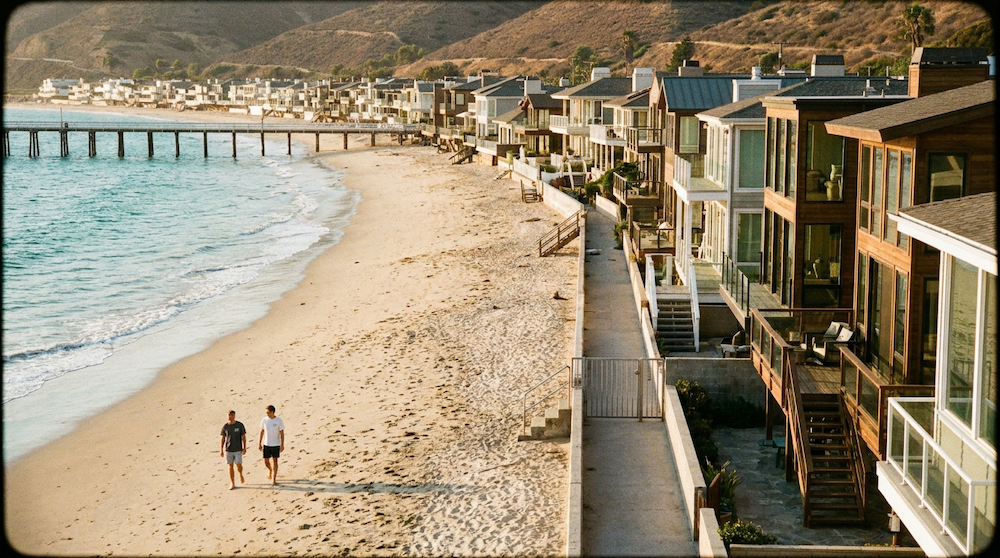
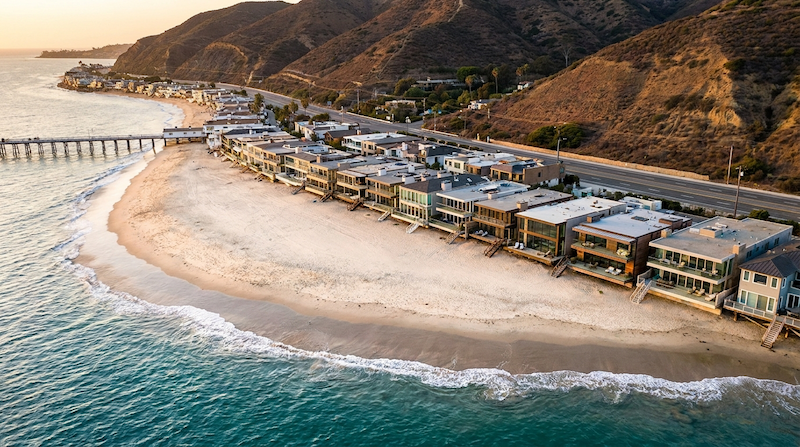
There is a crescent of beach in Malibu that runs roughly a mile and a half, from Carbon Canyon Road to just past the Malibu Pier.
It contains about seventy oceanfront lots. That's the entire supply. Nobody is making more of them, and the people who own them are not generally motivated sellers.
It's called Carbon Beach, and it has been the most expensive stretch of sand in California for around thirty years.
The numbers
Homes here trade from roughly $10 million at the bottom end to well past $50 million, with prices driven by frontage width, position on the crescent, and how much dry sand comes with the lot.
The record is Marc Andreessen's $165 million purchase in 2022 — one of the largest residential transactions in American history.
The ownership list reads like a shareholder register. Larry Ellison is reported to own at least a dozen lots on the beach. David Geffen, Eli Broad, Haim Saban, Lou Adler, Jeffrey Katzenberg and Paul Allen have all held property here. It skews toward tech and business money rather than actors, who tend to cluster further west in the Malibu Colony.
One useful detail about how this market actually functions: a large share of activity here happens off-market, agent to agent, before anything reaches a public listing. The prices you read about are the exceptions that surfaced.
The gate
Now the part that makes this more than a rich-list article.
Under California law, the wet sand below the mean high tide line belongs to the public. You can walk the entire length of Carbon Beach legally, for nothing, and nobody can stop you.
The catch is obvious the moment you look at the aerial photograph. The houses form a continuous wall between the highway and the water. If you can't get onto the sand, the right to be on it is theoretical.
That's why public access easements exist. When a beachfront owner applies for a permit to build or expand, the Coastal Commission can require them to provide a public walkway to the beach as a condition of approval.
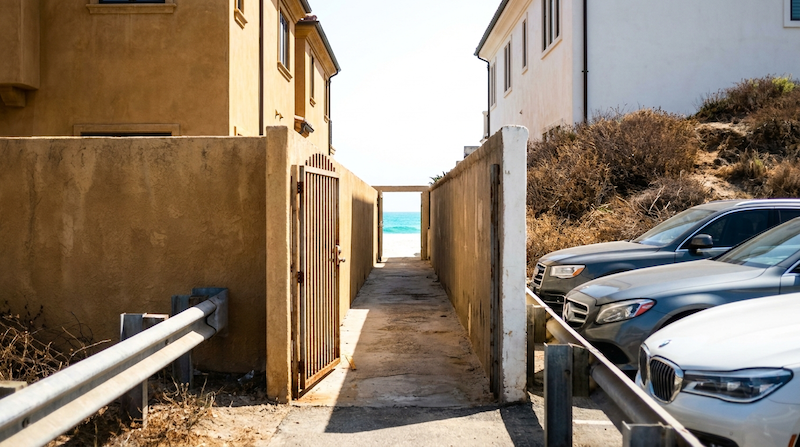
In 1983, David Geffen accepted exactly that condition in exchange for a permit to expand his Carbon Beach property.
Then he didn't open it.
The dispute ran for 22 years. It involved lawsuits, an advocacy group called Access for All, and an enormous amount of legal expenditure over a strip of walkway a few feet wide. The gate finally opened to the public in 2005.
A second accessway, further east, took its own multi-year legal fight before opening a decade later.
Why the law fight reshaped everything
That 25-year dispute over the dry sand in front of these homes didn't stay local. It changed how every California beachfront permit is handled.
The principle established is straightforward and, to beachfront owners, expensive: you can buy the house, but you cannot buy the beach. If you want permission to build on the coast, the public gets a way through.
It's worth appreciating how unusual that is. In most of the world, waterfront ownership includes practical control of the waterfront. California decided the coast is a public trust asset that private development is permitted to sit beside, not on top of.
The seventy owners of Carbon Beach collectively represent as much financial and legal firepower as any residential street on Earth. They fought this for over two decades. They lost.
What you're actually buying
Strip away the glamour and the asset here is unusual in a specific way.
Ocean frontage cannot be manufactured, subdivided, or built more of. The supply is seventy lots, permanently. A single sale at an unusual price resets the comparables for the whole of Malibu, because there's no volume to average it out against.
That's the mechanism behind the prices — not the houses, which are frequently demolished and replaced by new owners within a few years of purchase. Eli Broad famously bought two adjacent lots, knocked down what was on them, and commissioned a new building from architect Richard Meier. The structures are effectively disposable. The land underneath is the trade.
The risk nobody prices properly
One thing does not appear in the brochures.
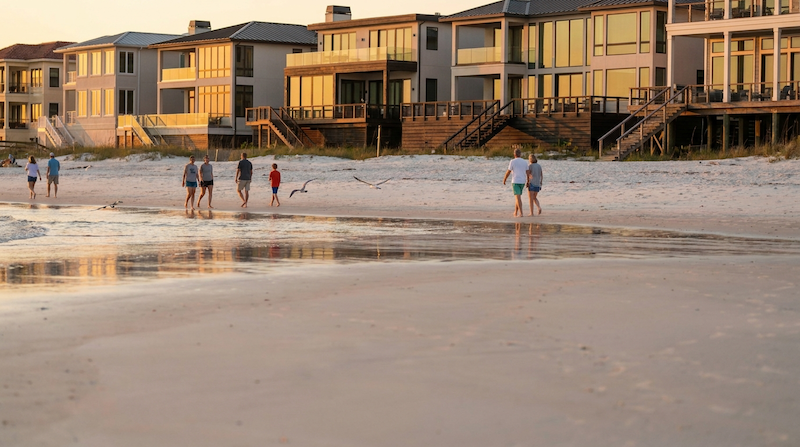
This is a narrow strip of low-lying sand between a highway and a rising ocean, backed by steep, dry, fire-prone hills. Malibu has repeatedly faced wildfire on the landward side and erosion on the seaward side, and the coastal permitting regime that governs seawalls and rebuilding is tightening rather than loosening.
The land is genuinely irreplaceable. It is also genuinely exposed, in two directions at once, and the insurance market in coastal California has been repricing that exposure rather than absorbing it.
My take
What I find genuinely interesting about Carbon Beach isn't the money. It's that the most expensive sand on Earth is also, legally, yours.
You can park on Pacific Coast Highway, walk down a concrete corridor between two $80 million houses, and stand on the same beach. Nobody can ask you to leave. The right survived a 22-year legal campaign funded by people who could afford to fight indefinitely.
That outcome was not inevitable. In most places the gate stays shut, and the public right quietly becomes a technicality nobody can exercise. California is unusual in having made the access physical rather than theoretical — and it took decades of litigation to convert a principle into an actual opening in a wall.
The seventy lots are the story people write about. The gate is the story that matters, and it's the reason a stretch of coast worth several billion dollars is still, in the way that counts, a public beach.