What If We Built A Mile-High Tower On The Moon?

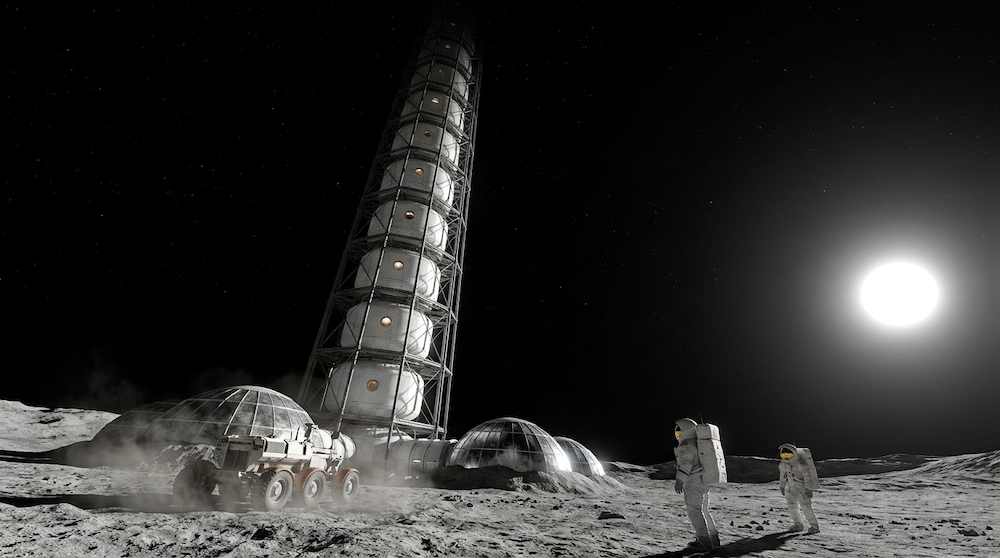
The Burj Khalifa stands 2,717 feet. Just over half a mile. It took about six years, 110,000 tonnes of concrete and an enormous amount of engineering effort to stop it from swaying its occupants into nausea.
Put the same structure on the Moon and almost every problem that made it hard evaporates.
Then a completely different set arrives, and they're worse.
The gravity math is genuinely absurd
Lunar surface gravity is about one sixth of Earth's — roughly 1.62 m/s² against 9.81.
For a building, that changes the fundamental limit. Every skyscraper is ultimately constrained by whether the material at the bottom can hold the weight of everything above it. Cut the weight by a factor of six and the same material supports six times the height before it crushes itself.
A structure built to Burj Khalifa engineering standards could, on that basis alone, reach several miles on the Moon.
And you get to delete the entire wind problem. On Earth, above about 60 storeys, lateral wind load — not weight — becomes the governing design factor. Tall buildings need tuned mass dampers, tapered profiles and spiral cutouts specifically to stop vortex shedding from shaking them apart.
The Moon has effectively no atmosphere. No wind. No rain. No freeze-thaw. No corrosion. No hurricanes. You could build something thin, spindly and structurally naive and it would stand.
The dust is the real problem
Lunar regolith is not sand. Sand has been rounded by water and wind over millions of years. Nothing on the Moon rounds anything.
The surface has been pulverised by micrometeorite impacts into particles that are jagged, glassy and often barbed, with a large fraction finer than 20 microns. Because there's no atmosphere or moisture to bleed off static charge, the particles hold an electrostatic charge and cling to everything they touch.
The Apollo missions ran straight into it. Dust ground through the outer layers of the astronauts' gloves and boots. It clogged joints and seals. It coated radiators, degrading their ability to shed heat. Brought inside the lander it got into everything, and crews reported irritation to eyes and throat from breathing it.
Harrison Schmitt, the geologist on Apollo 17 and the only trained scientist to walk on the Moon, described a reaction to it that got its own informal name — lunar hay fever.
For a permanent structure, this stops being an inconvenience and becomes the central engineering constraint. Every airlock, hinge, bearing, seal, solar panel and radiator on a mile-high tower has to survive constant contact with an abrasive that is chemically reactive, electrostatically clingy and sharp at the microscopic level.
Buildings on Earth are designed to resist weather. A lunar tower has to be designed to resist grit that never washes off.
Everything is a pressure vessel
Here is the difference between a building and a habitat, and it changes the entire design.
A building on Earth keeps weather out. A structure on the Moon keeps atmosphere in.
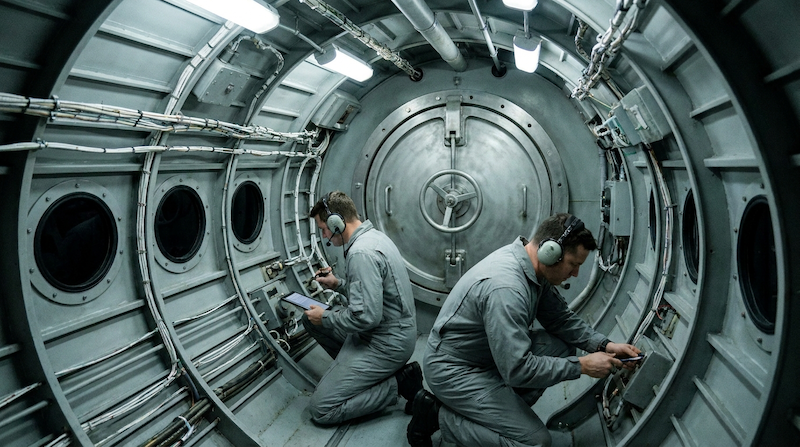
Every occupied level of a mile-high lunar tower has to hold internal pressure against a hard vacuum. That means the entire habitable volume is a pressure vessel, and pressure vessels want to be spheres and cylinders — not the flat-walled, window-heavy boxes we build on Earth.
The consequences stack up fast:
- Every window is a structural weak point in a wall holding back vacuum.
- The whole tower wants to burst outward, not fall down. Your structure is fighting inflation as much as gravity.
- A breach doesn't leak. It evacuates. There's no outside air pressure to slow the loss.
- Compartmentalisation becomes mandatory — the tower has to be a stack of independently sealable volumes, like a submarine turned on its end.
And then there's what's coming through the wall. No atmosphere means no protection from cosmic radiation, solar particle events or micrometeorites travelling at tens of kilometres per second. The standard proposal for lunar habitats is burying them under metres of regolith, which works fine for a low bunker and is not available to you a mile up.
What would actually get built first
Nobody is starting with a mile-high tower, and the reason is temperature, not height.
Lunar surface temperature swings enormously between the two-week day and the two-week night. That thermal cycling is brutal on materials and on any joint between two different materials.
The current serious proposals go the other direction — into lava tubes, under regolith, or in permanently shadowed crater rims near the poles where water ice may be accessible and temperatures are stable. Down, not up.
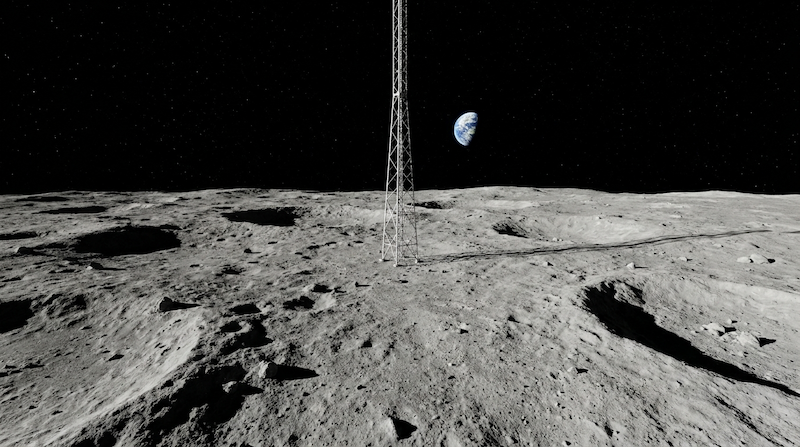
If a tall structure ever does go up, the plausible version isn't a residential skyscraper. It's a mast: solar collectors placed high enough to stay in sunlight through the lunar night, or communications antennas raised above the horizon. Unpressurised, unoccupied, and therefore free of the hardest constraint on the list.
My take
What I take from this is that our instinct about what makes construction hard is trained entirely on one planet, and it doesn't transfer.
On Earth, the enemy is load. Weight and wind. That's why tall buildings look the way they do — everything about their shape is a negotiation with those two forces.
On the Moon, load is nearly a solved problem, and the enemies are containment and abrasion. Holding air in, and surviving contact with a surface that behaves like microscopic broken glass. Neither of those is a structural engineering problem in the sense that a skyscraper engineer would recognise. They're materials science and sealing problems.
Which means the first mile-high structure on the Moon probably won't be designed by the people who build our tallest buildings. It'll be designed by people who build submarines and spacecraft — because the discipline you need isn't making something stand up.
It's making something that doesn't leak.