Seven Things Were in Every American Home in 1974

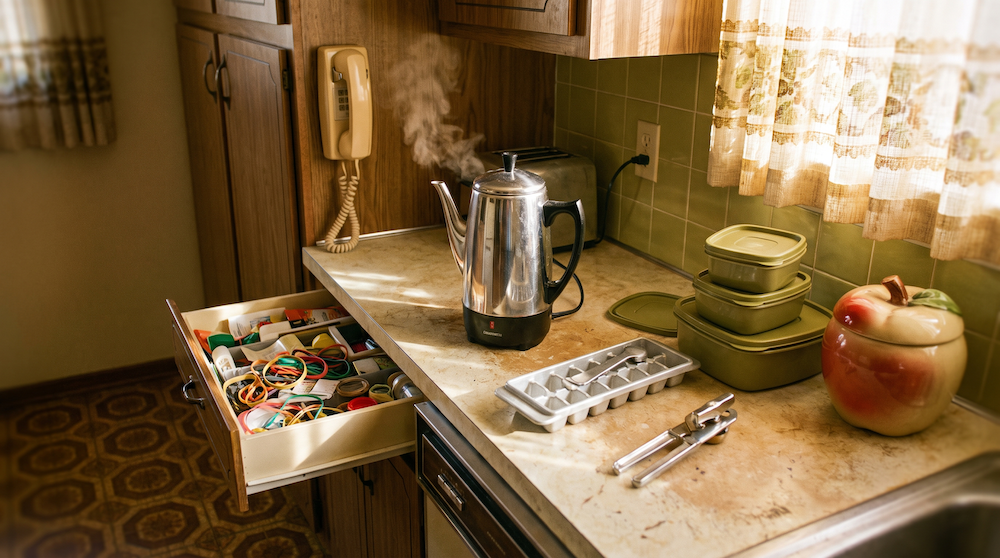
Ohio, 1974. Walk into almost any kitchen in the state and you'd find the same seven things. Not similar things — the same things, in roughly the same places, in millions of houses.
Six of them are effectively extinct. One is almost certainly within twenty feet of you right now.
Here they are.
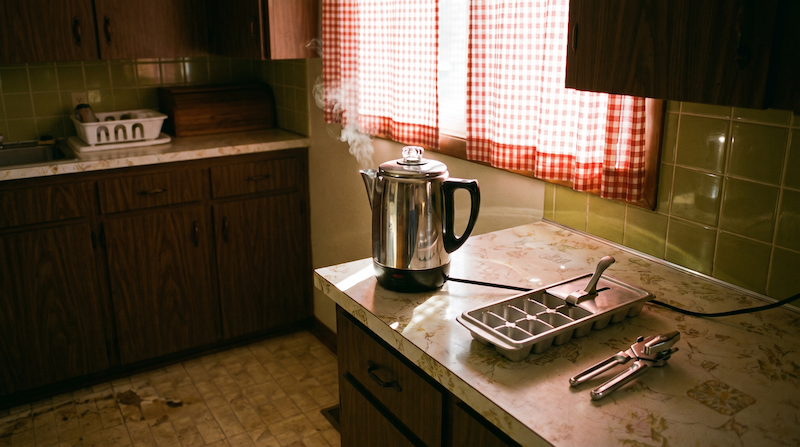
The metal ice tray. Aluminium, with a lever down the middle you hauled on until the cubes cracked loose with a sound like breaking bone. Half of them shot across the floor. The tray sweated and stuck to your fingers if it had been in there long enough.
Now: the freezer makes ice by itself, or you buy a bag. The lever survives only in antique shops, where people who yanked one a thousand times pay eighteen dollars for the nostalgia.
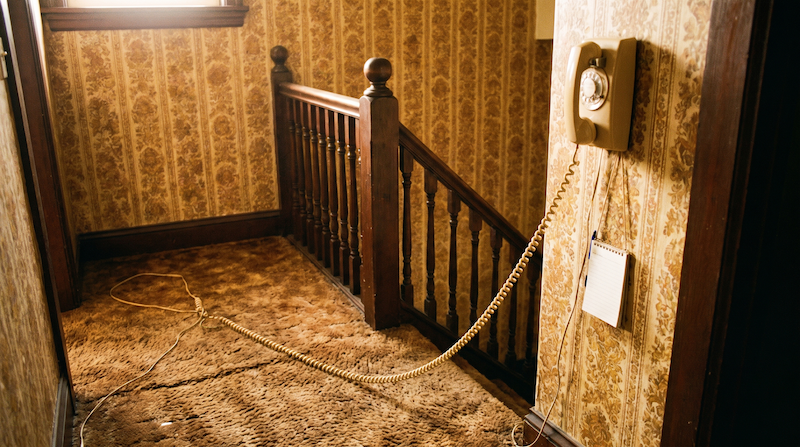
The wall phone with the long cord. Mounted at head height in the hallway, with a coiled cord that stretched — under tension, whitening at the coils — far enough to let a teenager sit on the stairs and get maybe nine feet of privacy. Everyone in the house heard half the conversation.
Now: the phone is in your pocket and the privacy is total. What went with the cord was the household's shared knowledge of who was calling whom.
The hand crank can opener. Clamped to the counter or pulled from a drawer. Twenty-five turns, and a lid with an edge sharp enough to matter. Nobody thought this was a chore because there was no alternative to compare it to.
Now: an electric one, or a pull tab moulded into the can itself.
The green plastic containers that never matched their lids. Every household had a cupboard of them and every household had the same problem. You'd find the lid two weeks later behind the roasting tin.
Now: clear plastic, glass with clipped edges, and the identical unsolved problem. This is the one item on the list where fifty years of design has changed the colour and nothing else.
The percolator. Twenty minutes, and it announced itself — the bubbling in the glass knob on the lid, the smell filling the house well before anyone got a cup. Coffee was an event with a soundtrack.
Now: forty seconds and a pod. Better coffee by almost any measure, and no smell in the hallway, no sound from the kitchen, no twenty-minute warning that the morning was starting.
The cookie jar nobody was allowed to open. Ceramic. Usually shaped like something — an apple, a bear, a chicken. On top of the fridge or on the counter, and it had a rule attached to it enforced by whoever ran the kitchen.
Now: the pantry is open, the snacks are in the cupboard, and the ceramic bear is in a cabinet somewhere as a keepsake. This is the only item on the whole list whose actual purpose was to say no, and it's the one that vanished most completely.
And the one that survived
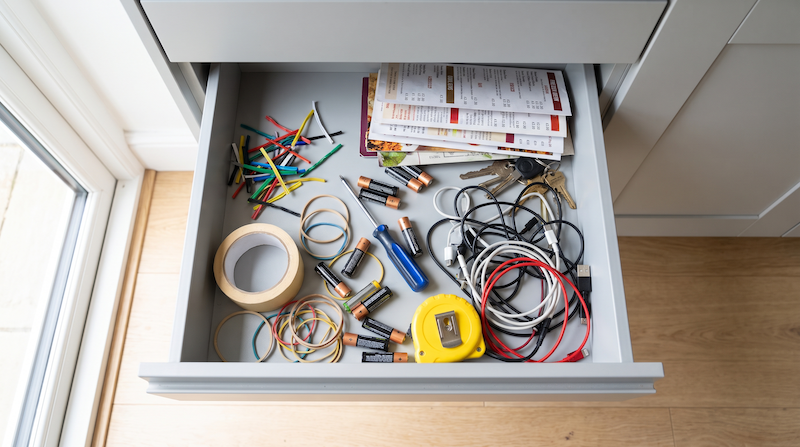
The drawer full of twist ties.
It's still there. Maybe not twist ties specifically — the bread bag now has a plastic clip — but the drawer itself is intact, in the same position, doing the same job.
Open it. There will be rubber bands. Batteries of uncertain charge. A tape measure. Takeaway menus. Allen keys from furniture you no longer own. Chargers for devices that are gone. A single key that fits nothing.
Six of the seven objects on that list were replaced by better technology. The seventh could not be replaced, because it isn't technology. It's a category.
Every household generates small useful objects that don't belong anywhere. Fasteners, spare parts, things too functional to throw out and too miscellaneous to file. That flow has never stopped and no product has ever solved it, because the drawer's job is to hold precisely the things that resist being organised.
The twist ties changed. The drawer didn't.
What the comparison actually shows
Line the two kitchens up and the differences aren't really about convenience.
Then, the kitchen made noise. The percolator bubbled. The ice cracked. The phone rang for the whole house and someone shouted a name up the stairs. You could stand in the next room and know what was happening.
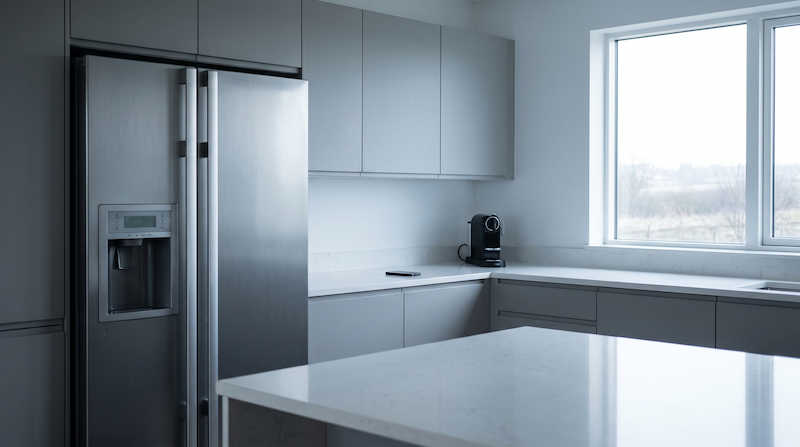
Now, the kitchen is quiet. The fridge makes ice silently. Coffee arrives in seconds. Your phone rings for you alone, on vibrate. A modern kitchen at 7am gives off almost no information about what anyone in the house is doing.
Then, everything was fixable. A cord, a lever, a crank, a ceramic lid. If it broke you tightened a screw or you lived with it. Now the ice maker is a sealed module and a service call.
Then, most of it was communal. One phone, one jar, one pot of coffee, all shared and all governed by rules everybody knew. Now almost every one of those has been individualised — your phone, your pod, your snacks, your schedule.
My take
I don't want to do the easy version of this, where everything old was warm and everything new is cold. The percolator made worse coffee. The ice tray was genuinely annoying. Nobody who lived with a hand crank can opener misses it.
What I think we actually gave up is friction that happened in front of other people.
Twenty minutes of percolator meant twenty minutes of somebody standing in the kitchen. A corded phone meant the call happened where the family was. A shared cookie jar meant a small daily negotiation with a parent. None of those were designed to create contact — they created it as a side effect of being slow and stuck in one place.
Efficiency removed the friction, and the contact came off with it. That's not a conspiracy or a decline. It's just what happens when every task in a room gets faster and more private at the same time.
And then there's the drawer.
It survived because it was never solving a technical problem. It's the one part of the 1974 kitchen that no amount of engineering could optimise away, because its entire function is to be the place where optimisation fails.
Fifty years of progress, and the most durable object in the American kitchen turned out to be the one nobody designed.
So: how many of the seven did you have? And go open the drawer — I'd bet money there's a key in there that doesn't fit anything.