A Whale's Stomach Is Full of Things It Never Ate

Start with the number that makes everything else make sense.
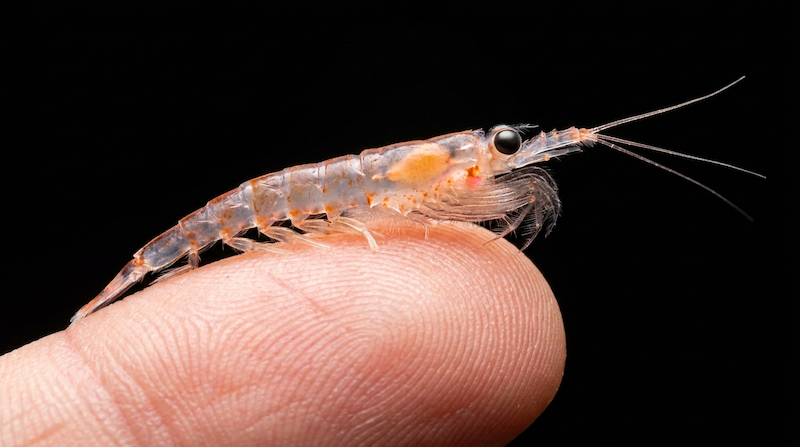
A blue whale weighs up to 150 tonnes. A krill weighs about one gram.
The whale is roughly 150 million times heavier than the thing it eats. Scaled to a human being, that's a 70-kilo adult surviving entirely on particles weighing half a milligram — smaller than a grain of sand, eaten one at a time, forever.
Now let's follow the food in.
The mouth: a school bus per day
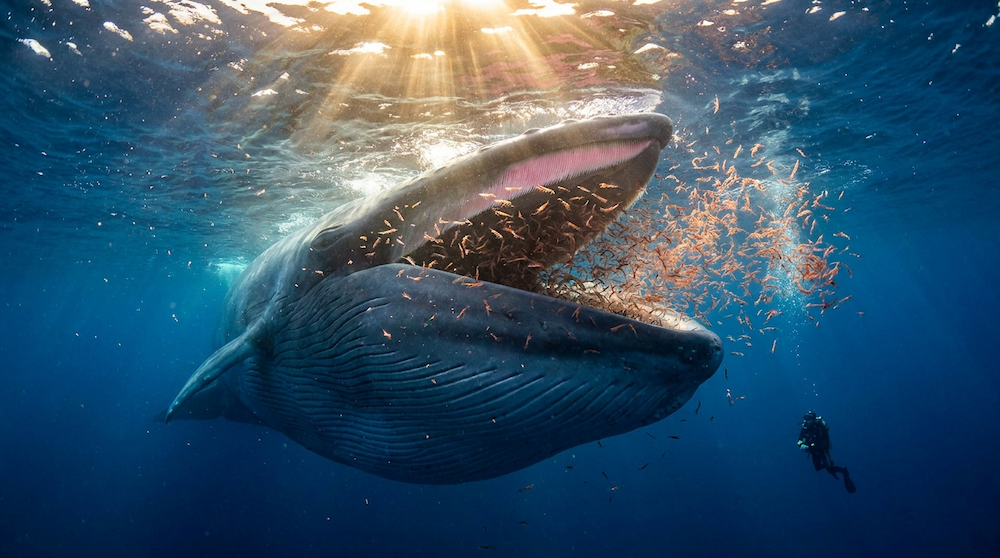
A 2021 Stanford study led by Matthew Savoca finally measured this properly, by tagging whales with devices carrying cameras, microphones, GPS and motion sensors, and using sonar to measure how dense the surrounding prey actually was.
An adult blue whale in the North Pacific eats around 16 tonnes of krill in a single feeding day — roughly three times what scientists had assumed. One of the study's co-authors described that as about the weight of a fully loaded school bus.
North Pacific humpbacks manage around 9 tonnes a day, fin whales about 8.
Sixteen tonnes of one-gram animals is somewhere around 16 million individual krill, swallowed in a day.
The throat: the bottleneck nobody expects
Here's the fact that ruins every sea-monster story ever told.
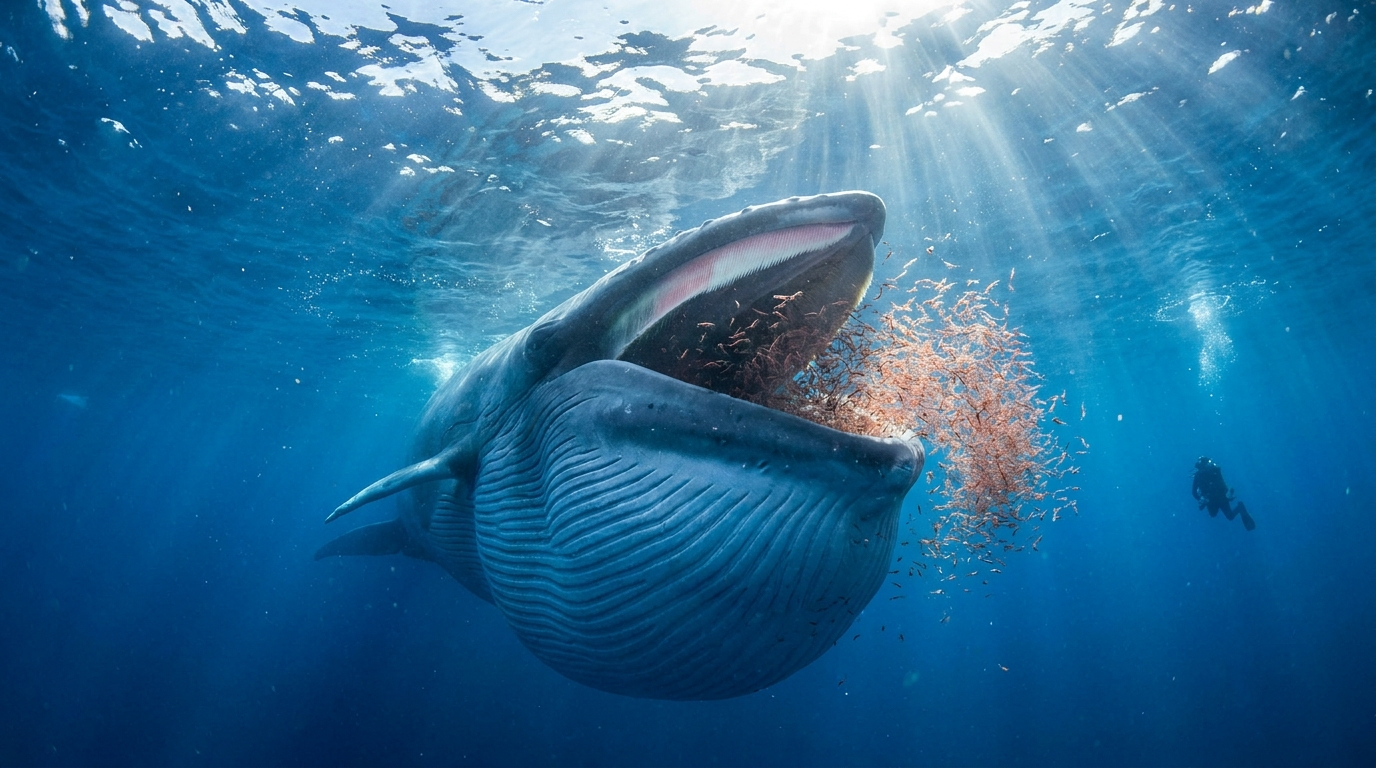
A blue whale can take in a volume of water heavier than its own body in one gulp. Its mouth is big enough to hold a small crowd of people.
Its oesophagus is roughly the width of a grapefruit.
That's the whole design. The mouth is a filter, not a swallowing organ. Baleen plates — made of keratin, the same material as your fingernails — strain the krill out while the tongue pushes the water back through the bristles. Only the strained material goes down the pipe, and the pipe is small.
So the largest animal that has ever existed on this planet physically cannot swallow anything bigger than a melon.
Sperm whales are the exception, and they're the reason the story exists at all. They're toothed whales that hunt individual large prey in the deep, and their throats are wide enough to take a squid — or, theoretically, a person — whole.
The forestomach: a gizzard the size of a room
Whales don't have one stomach. They have a chambered system, and the first chamber is the strange one.
The forestomach has no digestive glands at all. It has thick muscular walls, and its job is purely mechanical — it crushes and grinds prey before anything gets chemically digested. Functionally, it's a gizzard, like a bird has, scaled up to the size of a small vehicle.
Only after that does the material pass into the main glandular stomach where acid and enzymes take over, and then through a connecting channel to a pyloric chamber before the intestine.
The beaks
Now the sperm whale, and the number in the headline.
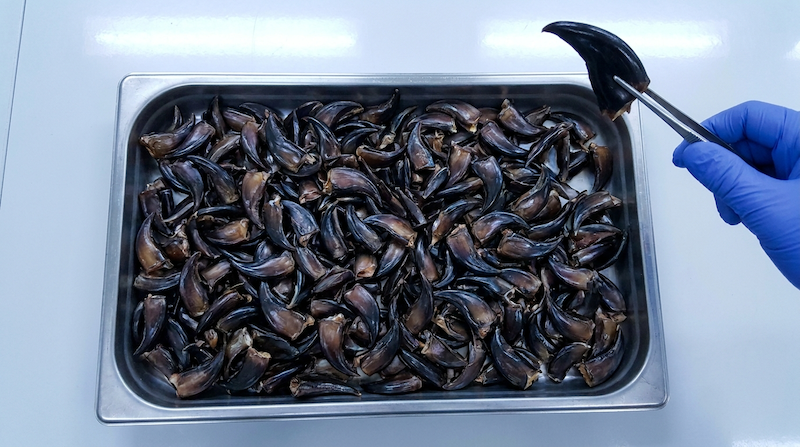
Squid bodies are almost entirely soft tissue, and a sperm whale digests them completely — except for one part. A squid's beak is made of chitin, hard and chemically stubborn, and the whale's digestive system cannot break it down.
So they accumulate. Open a sperm whale's stomach and you find beaks. Thousands of them. One recorded stomach held roughly 18,000.
This turned out to be one of the most valuable accidents in marine biology. For decades, almost everything science knew about deep-ocean squid — including the colossal squid, which nobody had filmed alive — came from measuring beaks pulled out of whale stomachs and working backwards to the size of the animal they came from.
A sperm whale's stomach is a sampling device for a part of the ocean humans still can't reach. Each one is a filled-in survey of what's living a kilometre down, collected by an animal that had no idea it was doing science.
The intestine: floating gold
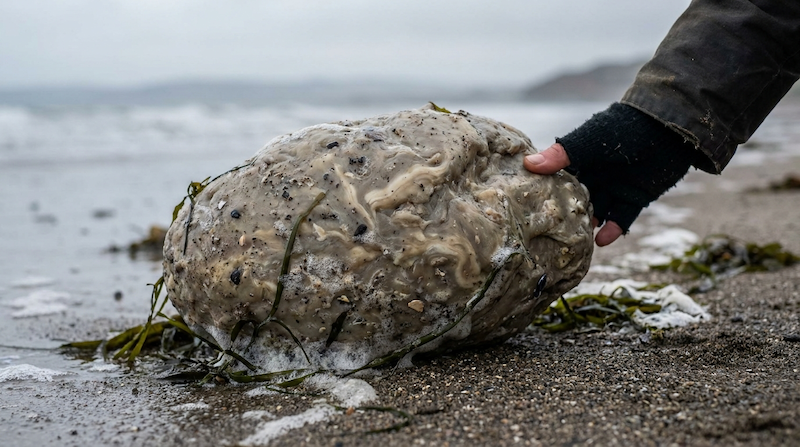
Sometimes those beaks don't pass. When enough of them irritate the gut, the sperm whale secretes a waxy substance around the mass, and over years it hardens into ambergris.
Fresh, it smells terrible. Aged at sea for years or decades, it develops a warm, sweet, oddly organic smell that the perfume industry has valued for centuries as a fixative. Lumps found on beaches have sold for tens of thousands of dollars.
It's the only substance I know of where an animal's inability to digest something turns into a commodity worth more per kilo than silver.
The passengers
Whale stomachs are also habitats.
The main resident is Anisakis, a nematode worm whose entire life cycle depends on ending up in a marine mammal. Eggs hatch in the water, larvae are eaten by crustaceans, crustaceans are eaten by fish and squid, and the worms concentrate in the fish. When a whale eats the fish, the worms mature and reproduce in the whale's stomach.
You may have already met them. When humans eat raw or undercooked fish carrying those larvae, the result is anisakiasis — the reason sushi-grade fish is required to be frozen at low temperatures first. The parasite that evolved to live inside a whale occasionally ends up in a person by mistake, because we eat the same intermediate host.
There are others: acanthocephalan worms hooked into the intestinal wall, tapeworms, flukes. A large whale is carrying a small ecosystem in its gut at all times.
The thing that shouldn't be there
The modern additions are worse.
Because baleen whales feed by filtering enormous volumes of water, they collect whatever else is suspended in it. A modelling study estimated that blue whales off California ingest around 10 million pieces of microplastic per day — up to 95 pounds of plastic waste.
Savoca made the mechanism uncomfortably clear: these whales are lower on the food chain than their size suggests, which puts them closer to where the plastic is. The krill eat the plastic, and the whale eats the krill. One link.
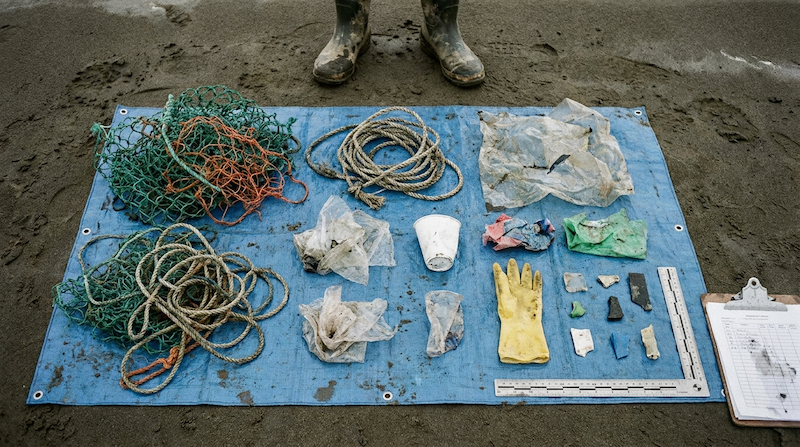
And on the toothed-whale side, the cases are grimmer and more visible. Stranded sperm whales and beaked whales have been found with stomachs packed with fishing nets, rope, plastic sheeting, cups and gloves — in some cases tens of kilograms of it, blocking the gut entirely.
My take
The scale numbers get all the attention, and they should — 16 tonnes a day is genuinely hard to hold in your head.
But what I keep coming back to is the oesophagus. The largest animal in the history of life on Earth has a throat you could block with a grapefruit. It got that big by going smaller, not bigger — by giving up the ability to eat large prey entirely and specialising in filtering the smallest animals in the ocean at enormous volume.
Everything about how we imagine giant predators is backwards here. The blue whale didn't win by being able to eat anything. It won by being able to eat almost nothing, in unimaginable quantity.
And that's exactly why the plastic problem hits it hardest. An animal at the top of a food chain gets one filtered dose. An animal that eats 16 million individual organisms a day, one link away from the plankton, is drinking the ocean itself.
Which means the stomach of a blue whale is now the single best measurement we have of what we've put in the water — and nobody asked it to be.