
5,000 Women a Year Are Taken Off the Street. It's Called "Grab and Run."

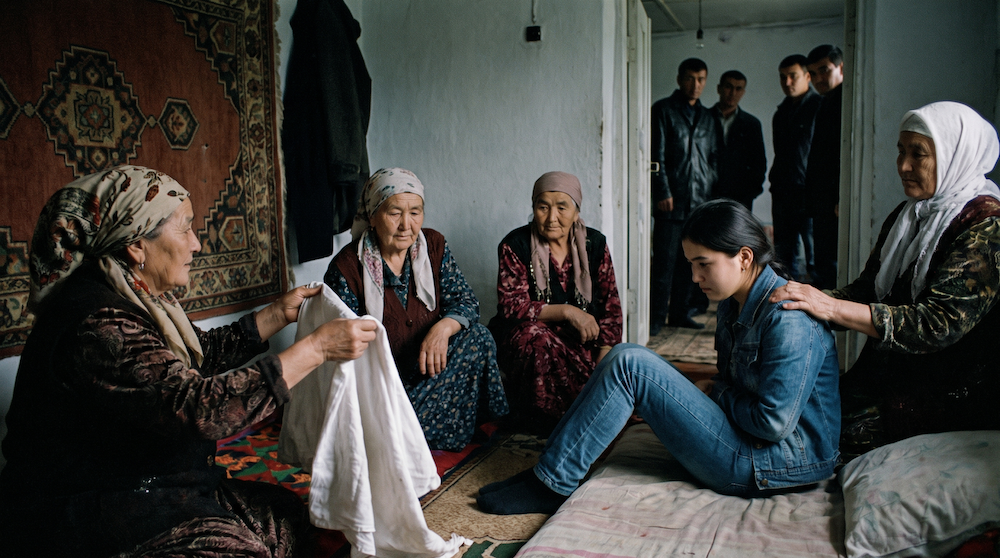
They Put a White Scarf on Her Head — And by Morning She's Married to a Stranger
The Kyrgyz name for it is ala kachuu. It translates roughly as "grab and run."
That's not a euphemism invented by outsiders. That's what it's called locally, and it is exactly what it describes: a man decides he wants a wife, gathers a few friends or male relatives, drives around, and takes one.
The woman is often pulled off the street, forced into a car, and driven straight to his house — where, in many cases, the family has already begun preparing for a wedding that she hasn't agreed to.
She usually has a few hours to refuse. Around 84% don't.
The scarf is the whole mechanism
Here's the part that people find hardest to understand from the outside, and it's the part that actually explains everything.
Once she's inside the house, the men mostly step back. It's the female elders of the groom's family who take over — aunts, grandmothers, his mother — and they work on her for hours. The goal is to get a white scarf, a jooluk, onto her head. That scarf is the signal that she consents. After that she's expected to write a letter to her own family asking permission to marry.
And here's the trap. Local custom holds that once a woman has been inside a man's house, she is no longer considered pure. Going home would shame her family — so often her own parents add their pressure to his, rather than come and take her back.
Read that again. The most effective people in the room are women. The second most effective are her own parents. By the time she's inside that door, everyone she would normally turn to has a reason to want her to say yes.
She isn't overpowered. She's surrounded.

It is not an ancient tradition
This is the fact that changed how I saw the whole subject, and almost nobody mentions it.
The Russian Empire outlawed it. The Soviet Union outlawed it. And after the USSR collapsed in 1991, it came back — as part of a broader revival of "old customs" used to assert national identity. Researchers describe it as a newly traditional practice.
So the version practised today isn't an unbroken thread from the nomadic past. It's a modern reconstruction, wearing the clothes of one, in a country where a young man who can't afford the traditional bride price has found a shortcut that his community will forgive him for.
I think that's the most important thing in this article. When something is called "ancient tradition," we hesitate. It sounds like culture, and criticising culture feels like arrogance. But a practice that two consecutive governments banned, that faded for decades, and that came roaring back in the 1990s is not an inheritance. It's a choice being made right now, by people alive today.
The numbers
Estimates vary widely and the honest answer is that nobody knows precisely — the crime is underreported by design.
Freedom House has put non-consensual kidnappings at around 5,000 a year, with roughly 2,000 of those involving rape. The UN Population Fund links a large share of Kyrgyzstan's child marriages — nearly 1 in 10 girls married before 18 — to bride kidnapping. Marriages that begin this way show markedly higher rates of domestic abuse, divorce and suicide.
Abduction for marriage carries up to seven years in prison. UNDP research found around 70% of these criminal cases collapse before conviction.
Seven years on paper. Seven in ten cases falling apart in practice.

Burulai
In 2018 a nineteen-year-old named Burulai Turdaaly Kyzy was abducted. Police found her and her kidnapper and brought them both to a station.
He stabbed her to death inside the police station.
There is no framing of this as culture that survives that room. She had reached the authorities. She was inside the building. It still didn't save her.
Her death triggered protests across Kyrgyzstan, and there have been others since — women killed after refusing, cases that made national news and forced the conversation open. That conversation is being led by Kyrgyz women themselves, which is worth saying clearly. This is not outsiders judging a culture. It's a fight happening inside one.
What I think
I'll be direct, because I don't think this is a topic that rewards balance for its own sake.
Some ala kachuu is genuinely consensual — a staged elopement by a couple avoiding an expensive wedding or disapproving parents. That version exists, and it muddies the water usefully for everyone who benefits from the confusion. It lets a real abduction be described afterwards, by everyone involved, as "that's just how we got married."
That ambiguity is not a bug. It's the reason the practice survives.
And the thing I can't get past is how little force is actually needed. Nobody has to hold her down. The whole system runs on shame — on a rule that says a woman who has been in a man's house is ruined, whether she chose to be there or not. Remove that single belief and the entire practice collapses overnight, because there's nothing left holding her in the room.
That's not tradition doing the work. That's arithmetic.
If you've read about this before, I'd be curious what version you heard — mine was very different from what the research actually shows.