An Asteroid That Stops Is Worse Than One That Hits

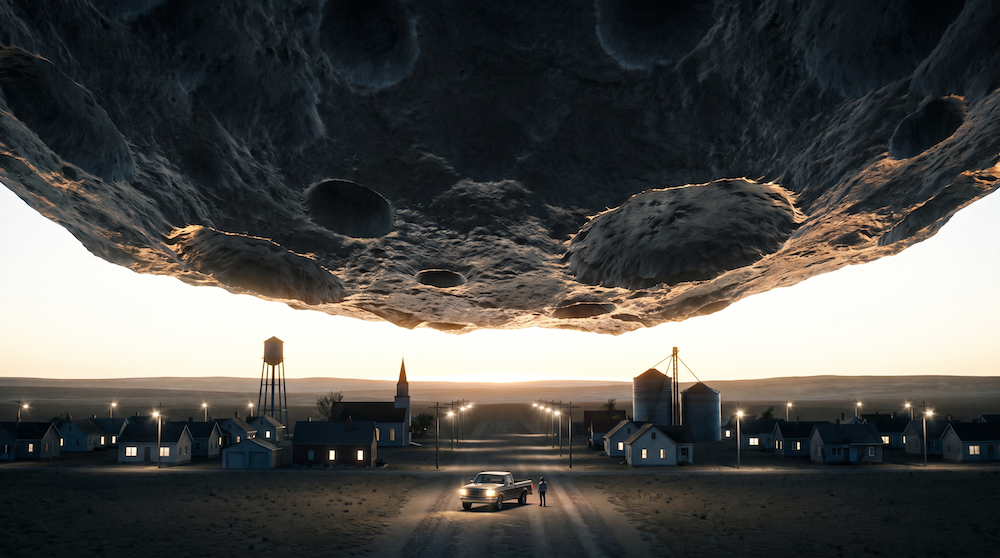
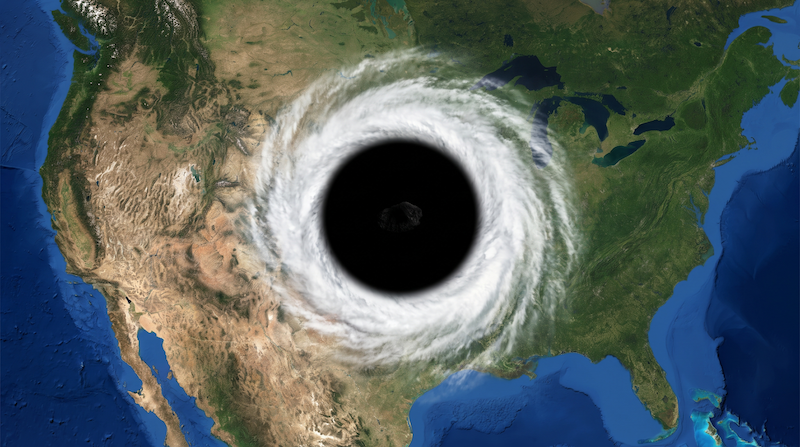
Picture a rock ten kilometres across — Chicxulub-sized, the dinosaur killer — coming to a complete stop twenty kilometres above Kansas. It doesn't fall. It just sits there.
Everyone's first reaction is relief. Nothing hit us.
That reaction lasts about ninety minutes.
It has already blocked out the sky
A ten-kilometre object at that altitude covers a patch of sky roughly the size of a small state. From directly underneath, it isn't an object in the sky. It is the sky.
Kansas goes dark at noon. Not dusk-dark — cave-dark, with a hard edge of daylight visible along the horizon in every direction, like standing at the bottom of a well the size of a country.
Ground temperature under the shadow starts dropping immediately. Within a day you have a permanent cold zone in the middle of the American breadbasket, and a ring of violent weather where that cold air meets normal daytime heating at the shadow's edge. Every boundary in the atmosphere is a storm generator, and you have just drawn a new one 300 kilometres wide.
The gravity problem is the real one
Here's what almost nobody thinks about.
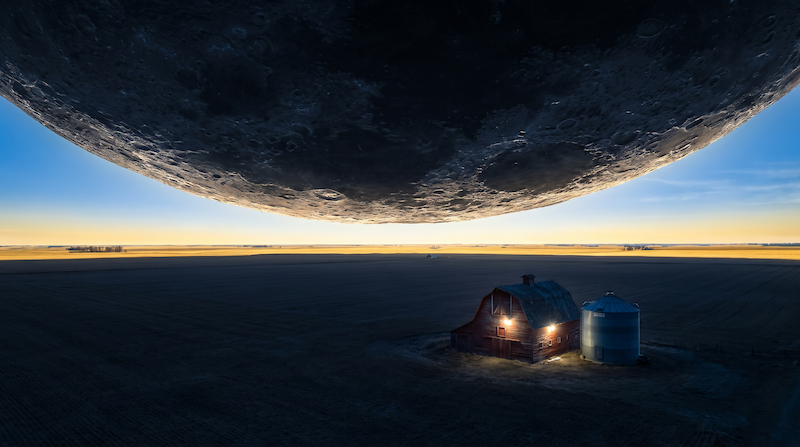
A body that size has real mass — somewhere in the range of a trillion tonnes. Park it twenty kilometres up and it's gravitationally closer to the ground beneath it than anything in human experience.
It pulls the atmosphere toward itself, thinning the air below and creating a permanent low-pressure anomaly. It pulls at groundwater. And critically, it pulls at the ocean — the same way the Moon does, except from 20 kilometres instead of 384,000.
That's a tidal bulge that doesn't move with the Earth's rotation. Coastal water levels along both American seaboards stop matching every tide chart ever printed, and stay wrong.
Whatever is holding it up is the actual emergency
This is where I think the scenario turns from a disaster story into something much darker.
Nothing in physics stops a trillion tonnes twenty kilometres above the ground. Not aerodynamics, not magnetism, not anything we can build. There is no natural mechanism.
So within hours, the question stops being what does the asteroid do and becomes what is holding it, and why has it chosen Kansas. Every scientific instrument in the country gets pointed at the gap between the rock and the ground, looking for the thing doing the work.
That's the horror in this scenario, and it's the thing disaster movies always miss. An impact is an accident. A hover is a decision.
What the government can and cannot do
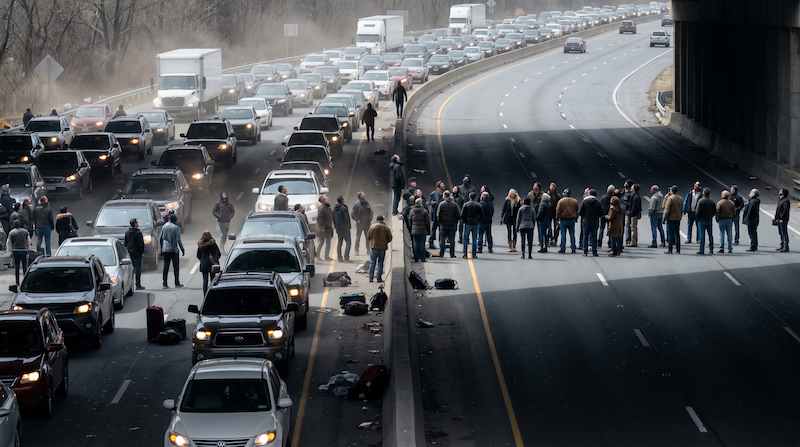
Evacuation is straightforward in principle and impossible in practice. The shadow zone alone covers several states. You are moving tens of millions of people out of a region that grows a large share of the country's food, on the theory that the thing might eventually fall.
And you cannot shoot it. Nuclear weapons don't vaporise a ten-kilometre body — they fragment it. Fragmenting it while it's stationary directly overhead converts one problem into ten thousand pieces of falling mountain distributed across the Midwest.
The honest military assessment would be that there is no available action that improves the situation, which is not a sentence any government has ever had to say out loud.
If it ever lets go
Twenty kilometres is not far. Dropped from rest, it reaches the ground in roughly a minute — far slower than a real impact, but with a mass so large that the kinetic energy is still civilisation-ending for North America.
The strange mercy is that a dropped asteroid does less damage than an incoming one. Real impactors arrive at 20 kilometres per second. This one would land at a fraction of that.
It would still erase the Midwest. It just wouldn't erase the species.
The verdict
- Hour one: several states go dark at noon.
- Day one: a permanent cold zone and a 300-kilometre storm ring around its edge.
- Week one: tides on both coasts stop matching every chart in existence.
- Ongoing: no weapon helps, no evacuation is realistic, and the food supply is under the shadow.
An asteroid that hits you is physics.
An asteroid that stops is somebody's choice — and that's a far worse thing to look up at.