Pompeii Gave People Eighteen Hours To Escape

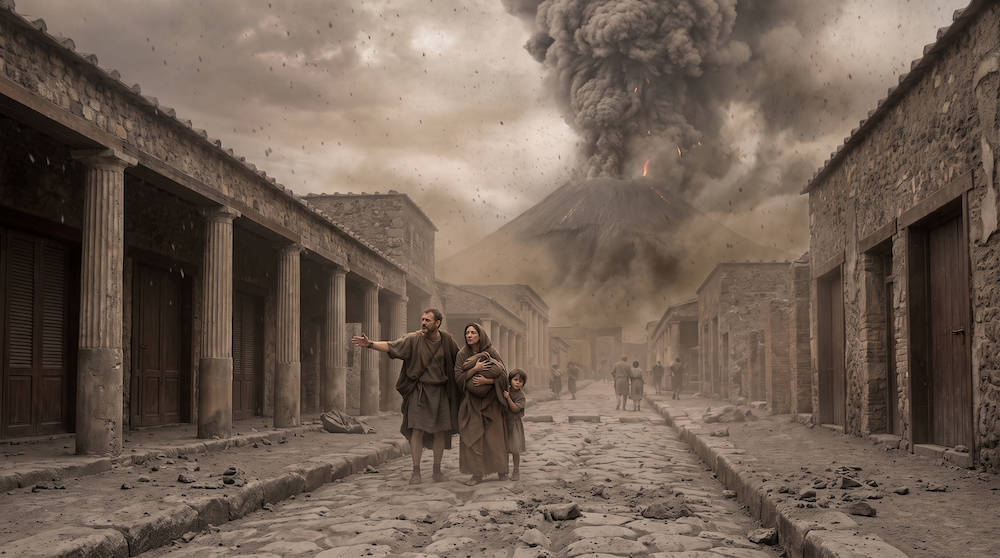
The story everyone knows is that Vesuvius erupted and Pompeii died instantly. A city frozen mid-breakfast.
The archaeology says something much worse. They had most of a day.
The eruption came in two acts
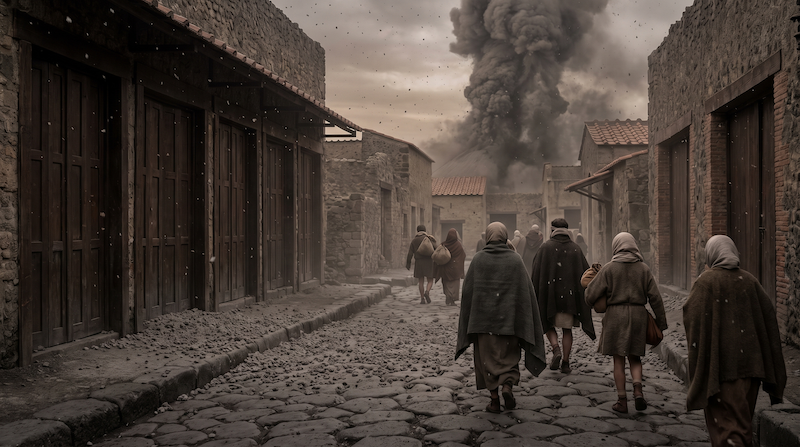
The first phase was pumice. Vesuvius threw a column of ash and lightweight stone tens of kilometres into the sky, and it fell back on Pompeii for something on the order of eighteen hours.
That fall was frightening but survivable. Pumice is light. It piled up on rooftops until they collapsed, and that killed people — but the roads out of town stayed open the entire time.
Most of Pompeii's population left. Estimates put the town at perhaps 12,000 people; roughly 1,000 to 2,000 bodies have been recovered. The overwhelming majority walked out.
The ones who stayed did something completely reasonable and completely fatal. They sheltered indoors and waited for it to stop.
Act two was the part nobody could survive
Then the column collapsed, and what came down the mountain instead was a pyroclastic surge — a dense ground-hugging cloud of ash and gas moving at around 100 kilometres per hour.
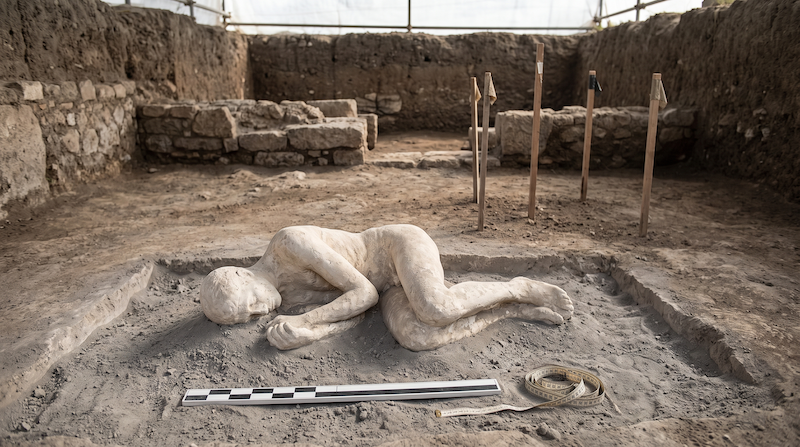
At Pompeii, research on the victims suggests death came from thermal shock rather than suffocation, at temperatures in the region of 250–300°C. That's fast enough that the famous body casts aren't people struggling. The clenched, curled posture in those casts is what intense heat does to muscle after death.
The people in the casts are not frozen in terror. They are frozen in chemistry.
Herculaneum got it far worse
The glass brain didn't come from Pompeii. It came from Herculaneum, a smaller seaside town much closer to the mountain, and it happened at night while Pompeii was still under falling pumice.
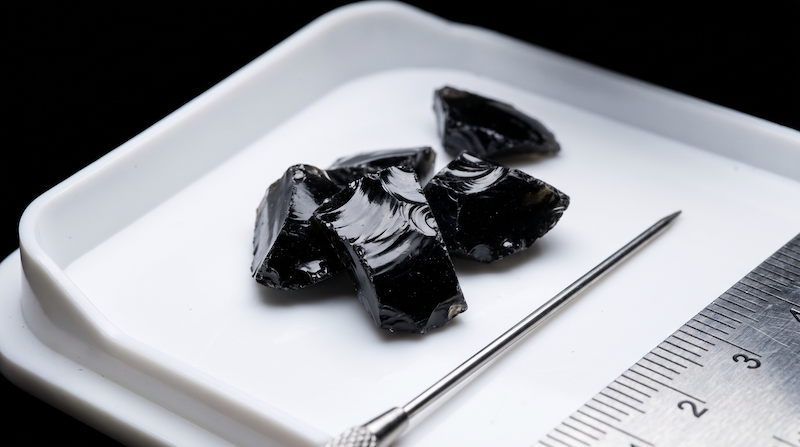
A forensic archaeologist at the University of Naples was studying remains excavated in the 1960s — a man believed to be about 20 years old, found lying face down on a wooden bed inside a building he may have been guarding. Inside his skull were dark fragments that looked like obsidian.
Analysis published in 2025 concluded the tissue had been heated above 510°C and then cooled rapidly, forming glass in a process called vitrification. The pyroclastic flows themselves couldn't have done it — they didn't exceed 465°C and cooled far too slowly.
So the researchers proposed something else: a fast, airborne ash cloud, hotter than the flows and quick to dissipate, that engulfed Herculaneum in seconds and killed everyone instantly. His skull and spine shielded the brain just enough to keep it from vaporising entirely.
Not everyone accepts it. An Oxford forensic anthropologist has said she isn't convinced the glassy substance is brain tissue at all — and that disagreement is worth knowing, because it's an extraordinary claim resting on one sample.
My take
The reason this story keeps its grip is not the volcano. It's the decision.
Eighteen hours is enough time to argue with your family. Enough time to go back for something. Enough time to convince yourself the roof will hold. Everybody who died in Pompeii made a series of ordinary, defensible judgements, and every one of those judgements was wrong.
That's why the casts are unbearable in a way that battlefield archaeology usually isn't. These weren't people who were ambushed. They were people who thought they had time, and they were right, until they weren't.
We do the same thing constantly — with storms, with evacuations, with anything where leaving is costly and the danger is still theoretical. Pompeii isn't a story about an ancient disaster. It's the oldest, best-preserved record we have of people waiting one hour too long.
The verdict
- The pumice phase lasted roughly eighteen hours and the roads stayed open.
- Most of Pompeii left. Those who died mostly chose to shelter indoors.
- The surge that finished them hit around 100 km/h at 250–300°C.
- Herculaneum was hotter, faster, and earlier — hot enough, once, to turn a brain to glass.
Nobody in Pompeii was caught mid-breakfast.
They were caught mid-decision.