Sea Creatures That Are More Dangerous Than They Look

The Deadliest Thing in This Article Is Probably in Someone's Living Room
We're trained to read danger visually. Teeth, size, speed, a shark fin cutting a surface. It's a decent instinct on land and it fails almost completely in the sea.
Almost nothing on this list looks threatening. Several look pretty. One is sold in shops as a decoration.
1. The blue-ringed octopus — the rings are the wrong warning

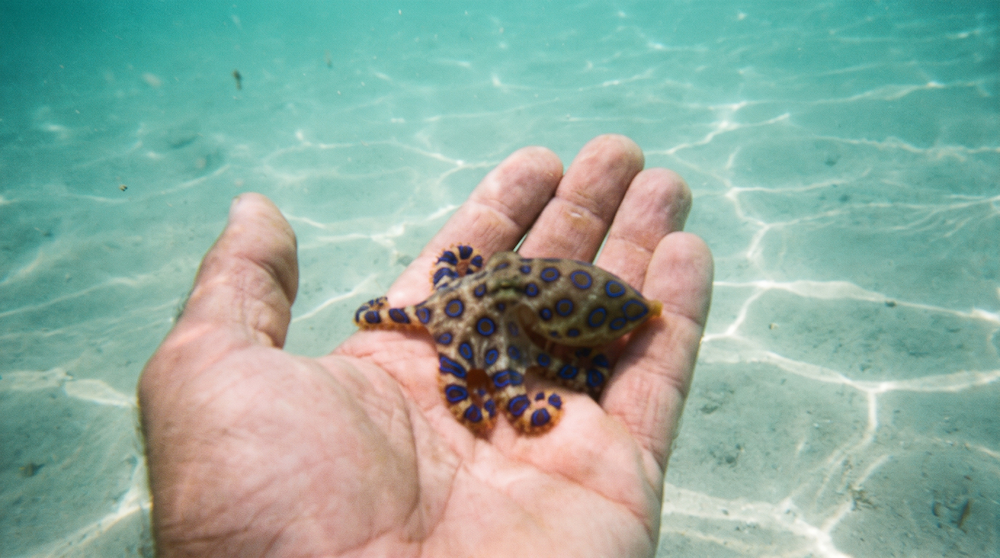
Everyone knows this one glows with electric blue rings. What people don't know is when.
A calm blue-ringed octopus is a drab brown-grey thing the size of a golf ball. The rings are barely visible. They flare into that famous neon blue only when the animal is alarmed — which means by the time you can identify it from the pictures, it's already agitated and you're already holding it.
The venom is tetrodotoxin, produced by bacteria living in its salivary glands. It blocks the sodium channels your nerves use to fire. The bite is often painless and can go unnoticed.
There is no antivenom. The treatment is to keep the person breathing artificially — sometimes for many hours — until the toxin clears on its own. Paralysis can be complete while consciousness remains intact.
That last detail is the one that keeps me up. People have been fully aware, and fully unable to move or breathe, waiting it out.
2. The cone snail — the shell people pick up

Cone snails have some of the most beautiful shells in the ocean, which is exactly the problem. They get collected off beaches and shallow reefs by people who think they're picking up an ornament.
The snail is a predator. It fires a hollow, harpoon-like modified tooth, and injects a cocktail of conotoxins — a single species may produce over a hundred distinct compounds. The geography cone, Conus geographus, hunts fish and is the species responsible for most recorded human deaths.
There is no antivenom for cone snail envenomation either. Treatment is supportive care and, again, keeping the patient breathing.
The pattern here is worth noticing: the fastest-acting marine venoms tend to be the ones we have no cure for, because the animal is too small and too rare for antivenom production to make economic sense.
3. Irukandji — a fingernail-sized jellyfish with a delay
Carukia barnesi has a bell about a centimetre across and is effectively transparent in water. You will not see it. You will barely feel the sting.
Then nothing happens for twenty to thirty minutes.
What follows is called Irukandji syndrome: severe lower back pain, muscle cramps, vomiting, sweating, a dangerous spike in blood pressure, and — reported so consistently it's in the clinical literature — an overwhelming sense of impending doom. Patients tell doctors they are about to die and beg to be put out of it.
The delay is the cruellest part. People come out of the water fine, dry off, and collapse half an hour later with no idea what happened to them.
The syndrome was proven in 1964 by Australian physician Jack Barnes, who caught the tiny jellyfish and deliberately stung himself, his nine-year-old son and a local lifeguard to demonstrate the cause. All three ended up in hospital. It worked.
4. The flower urchin — the prettiest one

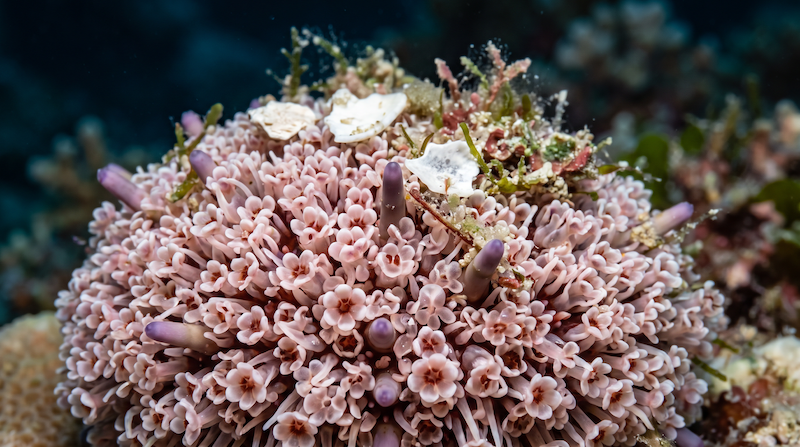
Toxopneustes pileolus looks like a small bouquet. Its surface is covered in what appear to be delicate pink-and-white blossoms, and it genuinely is one of the most attractive animals on the reef.
The "flowers" are the weapon. They're pedicellariae — tiny stalked pincers that clamp onto skin and inject venom. The spines aren't the danger; the flowers are.
Guinness World Records has listed it as the most dangerous sea urchin in the world. A Japanese researcher, Tsutomu Fujiwara, published a first-hand account in 1935 after being stung, describing severe pain, faintness, difficulty breathing and paralysis that took hours to subside.
It looks like something you'd photograph and touch. That is the entire design.
5. Zoanthid coral — the one in the living room
This is the one that genuinely surprised me, and the reason for the headline.
Zoanthids — sold in aquarium shops as "zoas," "button polyps" or "sun polyps" — are flat, colourful, sunburst-shaped soft corals. They're hardy, cheap and extremely popular. Some species contain palytoxin, one of the most potent non-protein toxins known.
You can't tell the toxic ones by looking. Health authorities advise aquarium owners to assume palytoxin is present, handle corals only underwater, and never with bare hands.
The documented cases are not theoretical. A CDC investigation in Alaska recorded people falling ill after zoanthids were handled in a home — including two who were asleep in an adjacent room, six metres from the tank. In 2017, a family of seven near Adelaide went to hospital after one member cleaned the household aquarium. Multiple similar poisonings have been recorded across the United States.
The mechanism is inhalation. Scrubbing, cutting or pouring hot water over the coral aerosolises the toxin, and it fills a room.
Statistically, more people are hurt by this than by anything else on this list — precisely because it isn't in the sea. It's on a shelf in the lounge.
6. The stonefish — a rock that isn't
Worth including because it inverts the whole premise: it doesn't look dangerous because it doesn't look like an animal.
Encrusted with algae and sediment, motionless on the seabed, it is a rock in every visual sense. People step on it. The dorsal spines drive venom in under body weight — the harder you press, the more you get.
The pain is described as among the worst in medicine. Antivenom exists for this one, which puts it ahead of most of the others here.
What I actually think
There's a pattern in this list and it isn't about the ocean.
Every animal here is dangerous because it's unremarkable. Nothing on this list needs to advertise. The venom exists so the animal doesn't have to fight, run or intimidate — it can be small, slow, pretty and completely uninterested in you, and still be one of the most consequential things you touch that day.
We got our danger instincts from a world of predators that had to catch us. Chemistry doesn't need to catch anything.
And the fact that the most likely one to actually hurt you is a decorative coral in a hobbyist's tank, not something lurking on a reef, tells you how badly those instincts translate to a world where we can order the ocean online.
Shuffle your feet in shallow water, don't pick up pretty shells, and wear gloves if you keep a reef tank. That's the whole safety brief.