The Reef Fish That Chases Divers — And the Escape Mistake Almost Everyone Makes

Ask most people what they're afraid of in the ocean and you'll get the same answer every time: sharks. It's the answer the movies trained us to give. But talk to people who actually spend their working lives underwater — dive guides, underwater photographers, instructors in Thailand, the Maldives, the Red Sea — and you'll notice something strange. They shrug about reef sharks. They get genuinely careful about a chunky, slow-looking, almost comical fish the size of a car tyre.
That fish is the titan triggerfish, and it has a reputation that sounds absurd until it happens to you: it charges. Not a warning flick of the tail. An actual, committed, repeated charge at an animal many times its size — and it will follow you.
I find this fascinating, because it flips the whole logic of the reef upside down. Almost everything else down there is running a survival strategy built on avoidance: hide, blend in, freeze, flee. The titan triggerfish decided the opposite. It decided that the best defence is walking straight at the problem.
What it actually is
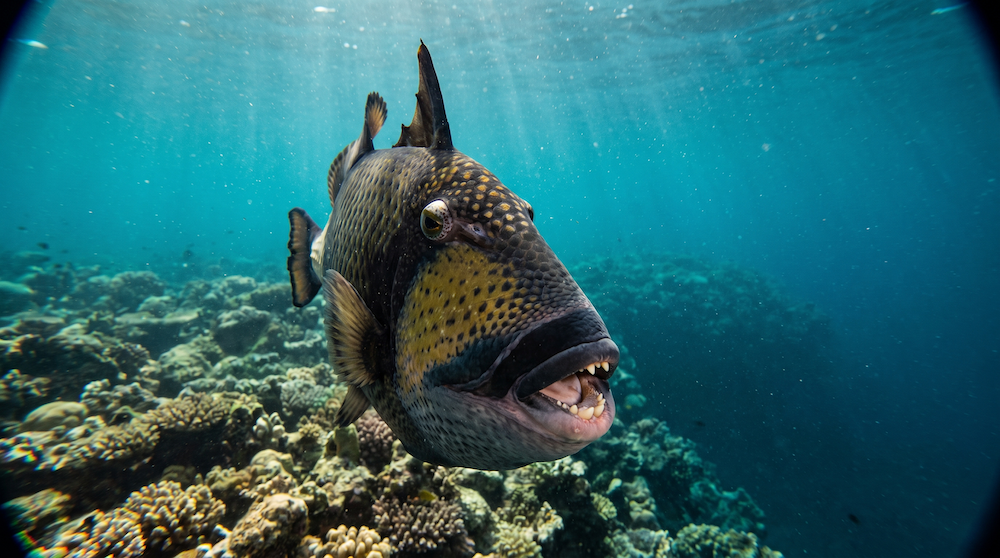
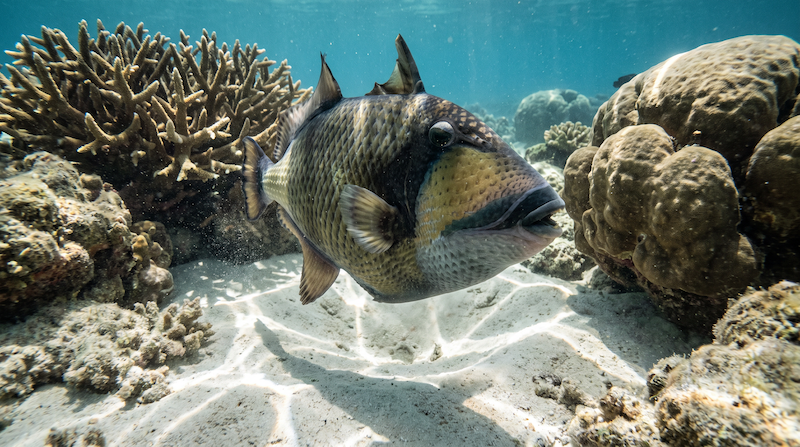
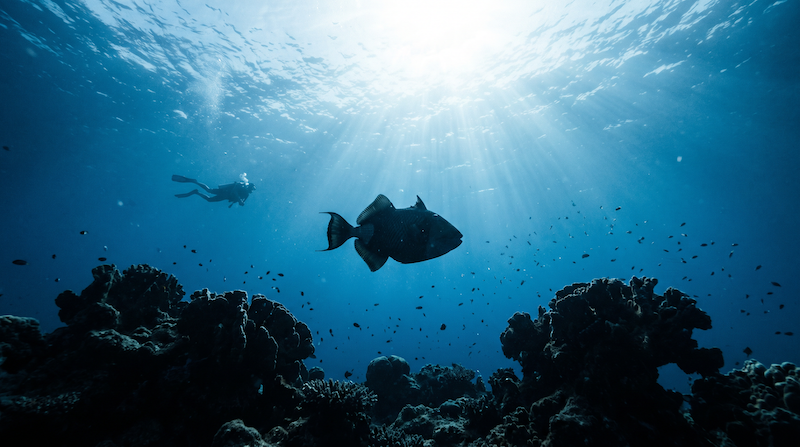
The titan triggerfish (Balistoides viridescens) is the largest triggerfish in its range, reaching roughly 75 centimetres — about two and a half feet — with a thick, oval, heavily armoured body. It has dark scales, a distinctive black-and-yellow-speckled mask around the eyes, and pale yellow fins edged in black. It lives across the Indo-Pacific and the Red Sea, and it's common on reefs around Koh Tao, Sipadan, the Similan Islands and the Maldives.
The "trigger" in the name has nothing to do with its temper, which is a small disappointment. It refers to the mechanism on its back: the fish can lock its first dorsal spine bolt upright, and a second, smaller spine acts as the release that unlocks it. In the wild this is a wedging device — the fish jams itself into a crevice at night, raises the spine, and becomes almost impossible to pull out. When a diver sees that spine snap upright in open water, though, it means something completely different. It means you are being warned.
Why it charges
Here's the part that changes how you think about the animal: it isn't hunting you. It's parenting.
During breeding season the female excavates a shallow round nest in a sandy patch, usually right beside or among the coral, and lays her eggs there. From that moment the nest becomes the centre of the universe. The fish guarding it will drive off anything that comes near — other fish, other triggerfish, and yes, a 90-kilogram human in neoprene trailing bubbles. It has no concept of your size. It has a concept of a boundary, and you crossed it.
I think that context matters, and I'd argue it's the reason the "killer fish" framing you see online is a bit lazy. This isn't a monster. It's an animal doing exactly what a nesting swan or a magpie in spring does — the only difference is that you can't hear it coming, and you're moving in three dimensions instead of two.
That third dimension is where people get hurt.
The invisible cone
The territory a nesting titan triggerfish defends is not a flat circle on the reef. It's a cone — narrow at the nest on the seabed, widening as it rises, extending all the way up toward the surface.
Read that again, because it's the single most useful fact in this entire article. The danger zone gets bigger the higher you go.
Now think about what a startled human does when something charges them underwater. They go up. It's pure instinct — up is air, up is out, up is safety. And it is exactly wrong. Swimming upward keeps you inside the cone, and often puts you deeper into it than you were before. Dive guides across Southeast Asia will tell you they've watched triggerfish escort divers all the way to the surface, still charging, still snapping, because the diver never actually left the territory.
The correct move is to swim horizontally, flat and away, keeping the fish in sight. Leave on a level plane. The instant you're outside the cone's footprint, the fish loses interest completely and returns to its nest. It doesn't pursue. It was never pursuing — it was evicting.
It tells you before it does it
The thing I genuinely admire about this fish is that it is not sneaky. It gives you a full escalation ladder, in order, and almost every bite story I've read is a story about someone missing the rungs.
- It stops and faces you. Turning head-on is the first statement: I see you, and you're close.
- The dorsal spine goes up. Locked upright. That's the second warning, and it's a serious one.
- It swims in tight zigzags or circles. People read this as curiosity or playfulness. It isn't. It's agitation.
- It rolls onto its side. This is the last one. Tilting lets it get a clean look at you with one eye and judge distance — it's lining up.
- Then it charges, and at that point it is not bluffing.
If you've reached stage two, you've already been asked politely. Go horizontal.
About those teeth
The bite is not a life-threatening injury, but it deserves respect, and I think people underestimate it because the fish looks soft and clumsy.
Those jaws are built to crush hard coral, sea urchins, molluscs and thick-shelled crustaceans — a chisel-like set of teeth in a short, powerful jaw designed for demolition work. Titan triggerfish are also famously destructive feeders, flipping over rocks, snapping off coral branches and blasting jets of water into the sand to expose prey. That's a lot of force in a small package. Bites have gone through fins and wetsuit material, and in the worst reported cases have required stitches.
There's one extra wrinkle worth knowing. Because the species feeds on reef organisms that accumulate ciguatoxin, titan triggerfish flesh can be ciguatoxic — which is why it's not a fish you want on your plate in many regions, and why any deep bite is worth having properly cleaned and looked at rather than shrugged off.
What I actually think about all this
I've read a lot of "most aggressive fish in the ocean" content, and most of it annoys me, because it takes an animal with a completely rational motive and turns it into a horror-film extra for clicks.
What's really going on here is far more interesting than a monster story. You have a mid-sized reef fish that has evolved a defensive strategy based on psychological dominance — on being so committed, so relentless and so obviously willing to escalate that vastly larger animals decide the fight simply isn't worth it. It works on sharks. It works on humans. It works because the triggerfish is prepared to go further than you are, over a patch of sand you never even noticed.
And honestly, the safety advice for it is the same advice that works for almost every animal encounter on Earth: read the warnings, don't take it personally, and leave the way the animal wants you to leave — not the way your panic wants you to.
If you're diving or snorkelling anywhere in the Indo-Pacific this year, the odds are good you'll meet one. Most of the time it will completely ignore you. But if you ever see a stocky, speckled fish stop, turn, and raise a spine on its back like a flag going up — go sideways.
Not up.
Have you had a run-in with a titan triggerfish? I'd like to hear how it went — drop it in the comments.