What If a Wild Tribe Woke Up in the Middle of New York City?

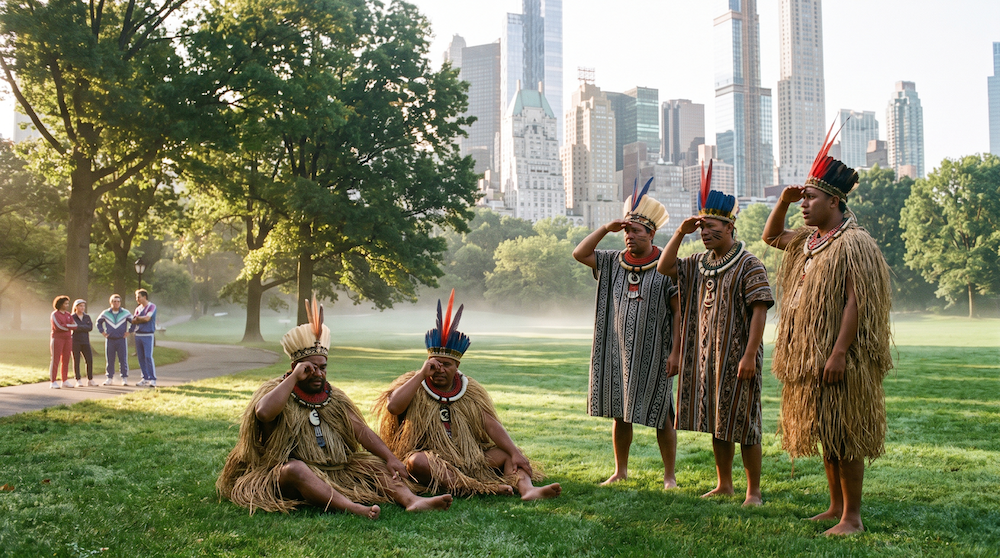
It sounds like a thought experiment you'd have at 2 a.m. Take a group of people who have never seen a road, a wheel, a written word, or a stranger — and put them down in the loudest, densest, most surveilled city on Earth.
Most people assume they know how this story goes. The tribe panics. The tribe is helpless. The city takes care of them.
Every part of that is wrong.
What follows is a completely hypothetical scenario, built on documented cases of what has actually happened when isolated peoples were pulled into the modern world. It is not a happy story. But it is not the story you think it is either.
Hour Zero: The Drop
It's 6:40 a.m. on a Tuesday in June. Twenty-two people — let's call them the Mareya, a fictional group standing in for the roughly 100 uncontacted communities still believed to exist worldwide — are suddenly standing on the traffic island at Broadway and 45th Street.
They are not screaming. That's the first thing that surprises everyone later, when the footage is analysed frame by frame.
They go silent, drop into a low crouch, and form a tight outward-facing ring with the children pushed into the centre. It takes them under four seconds. It is a predator response, drilled into them since childhood, and it is executed better than any crowd-control unit in the NYPD could manage.
Then they start reading the environment. Not panicking — reading. Where is cover. Where is water. What moves. What is a threat display and what is just noise.
Here is what their eyes actually solve first:
- The vehicles. Within an hour they understand that the metal animals move only on the black rivers, stop at the coloured lights, and cannot climb the pavement. That is a survival rule learned faster than most tourists learn the subway.
- The people. Thousands of strangers, none of them attacking. In their world, a stranger is either kin or a lethal threat. Thousands of non-attacking strangers is not just confusing — it is incoherent. Several of them will later be described as being in a state resembling shock, not from fear, but from a world that refuses to follow any rule.
- The sky. Glass towers with no visible top. A hundred years of Western fiction has told us they'd think it was heaven. More likely they'd think it was a cliff, and cliffs mean falling rocks, and falling rocks mean move.
By hour six they will have located Bryant Park, because it has trees and open sightlines. By nightfall they will have built a low shelter from cardboard and construction sheeting, and it will be structurally better than anything you or I could put together. By day three they'll be catching pigeons, and they will be very good at it.
The Thing That Actually Kills Them Is the Air
Here is the part almost nobody thinks about, and it's the part that ends the story.
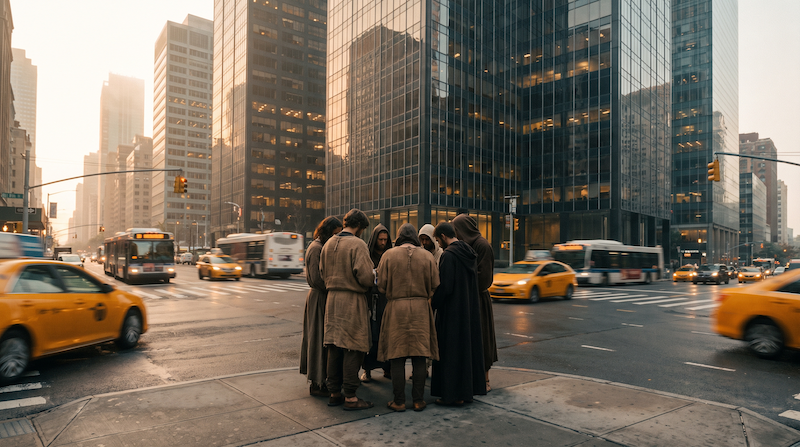
An uncontacted group has an immune system that has never met measles, influenza, whooping cough, chickenpox, tuberculosis, or the common cold. Not "low resistance." Zero prior exposure, across an entire population, with no herd immunity to slow the spread and no genetic memory of these pathogens at all.
We know exactly what that looks like, because it has happened repeatedly. When Peru's Nahua people were contacted in the mid-1980s, roughly half the group is reported to have died within a few years. Brazil's Matis lost a devastating share of their population after contact in the 1970s — enough that an entire generation of elders, and with them a huge part of their knowledge, simply vanished. This is the single most consistent outcome in the entire history of first contact.
Now put those people in a subway car at rush hour.
A single ride on the 7 train exposes a person to more distinct respiratory pathogens than their community encountered in a thousand years. By day four, someone has a cough. By day nine, most of the group is running a fever. By week three, the deaths start — not from anything exotic, but from a flu strain that a New York toddler would shake off in a weekend.
The realistic medical estimate is brutal and simple: without immediate, aggressive, isolated hospital care, most of the group is dead inside a month. With that care — full quarantine, IV fluids, antivirals, antibiotics for the secondary pneumonias — you might save most of them. But quarantine means locking twenty-two people who have never seen a door into separate sealed rooms, which brings its own casualties.
There is no version of this scenario where everybody lives.
Day Two: The City Reacts, and the Crowd Becomes the Disaster
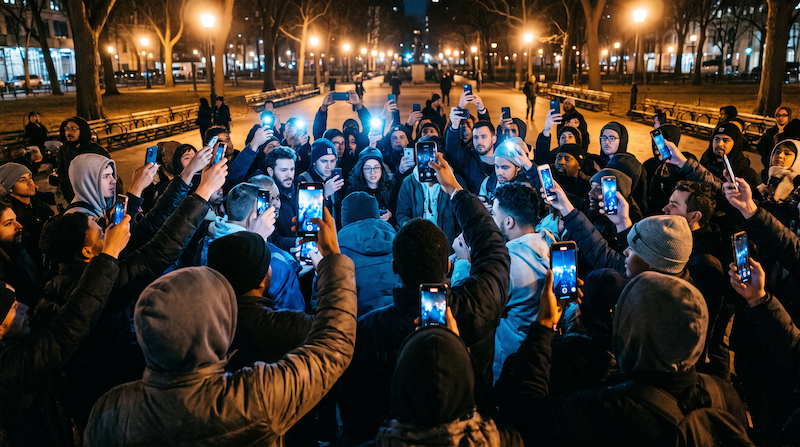
The first phone comes out within ninety seconds. Of course it does.
By 9 a.m. the footage is everywhere and the internet has split into camps: it's a marketing stunt for a streaming series, it's AI-generated, it's a Broadway flash mob, it's real. By noon, someone has identified the fibre in their clothing and the argument shifts.
By afternoon, the real danger arrives — not the police, not the traffic. The crowd.
Hundreds of people, then thousands, pressing in with phones, throwing food, shouting, trying to touch them, trying to get the shot. Every one of those people is a walking aerosol of viruses. The single most lethal object in this entire scenario is a friendly stranger holding out a half-eaten bagel and leaning in for a selfie.
The Mareya read this crowd exactly the way their instincts tell them to: as an encircling threat. And they respond the way they would respond to an encircling threat at home — with a defensive display, weapons raised, a warning that in their language and their world means stop, or we will defend ourselves.
On camera, in New York, that reads as an armed group threatening civilians.
This is the moment the story turns, and it turns on a mistranslation that neither side is capable of noticing.
Week Two: The Legal Nightmare Nobody Planned For
Then the paperwork starts, and it's worse than the medicine.
They do not legally exist. No passports, no birth certificates, no nationality, no country of origin anyone can prove. They are not immigrants, not tourists, not refugees under any definition written into law, because every one of those categories assumes you came from a recognised state.
That triggers a jurisdictional pile-up with no precedent:
- The CDC wants them quarantined immediately as a bidirectional biohazard — they're vulnerable to us, and there is a non-zero chance they carry something we haven't catalogued.
- Homeland Security has twenty-two undocumented individuals of unknown origin, several holding weapons, in midtown Manhattan.
- Family courts have to decide who has legal guardianship of the children, since no adult present can produce evidence of being their parent.
- The State Department has to work out which government to notify, when the group's homeland is possibly inside the territory of a country that officially denies they exist.
- Anthropologists and indigenous-rights organisations file emergency motions demanding no contact, no filming, and immediate repatriation.
And every single one of these processes takes weeks. The immune system takes days.
The law will still be arguing about their status at the funerals.
This Already Happened Twice. Both Times It Ended Badly.
The scenario isn't purely hypothetical, and that's what makes it land.
In 1911, a man walked out of the California wilderness — the last survivor of his people, the Yahi. Newspapers called him "the last wild Indian in America." He was given the name Ishi, and he was taken to live inside a museum in San Francisco, where he demonstrated toolmaking to the public on weekends. He was, by most accounts, treated with genuine affection by the researchers who knew him. He died in 1916 of tuberculosis — a disease he had no defence against.
Five years earlier, in 1906, a Congolese man named Ota Benga was put on display in the Bronx Zoo, in the monkey house, in New York City. Thousands came to look. Black clergymen in the city protested furiously and got the exhibit shut down, but he never made it home. He died in 1916.
So the honest answer to "how would New Yorkers react" is not a guess. New York has answered this question before, and the answer was: we put him in the zoo, and it took a protest movement to get him out.
We are better now. We are not as much better as we'd like to believe.
What Actually Happens to the Survivors
Say six of them live. What then?
They do not go home. They can't — after two months in a city, they are now carriers themselves, and returning them would introduce a dozen novel pathogens into a community with no immunity at all. Sending them back would kill everyone they love. This is the cruellest clause in the whole scenario: contact is a one-way door.
So they stay. And here's the part that gets underestimated by everyone.
They adapt fast. People who can track an animal by a bent stem, memorise a thousand square kilometres of forest without a map, and hold their entire culture's history in oral memory are not slow learners — they're some of the most capable pattern-processors on the planet. Within two years, at least one of them speaks functional English. Within five, one of the children is at grade level in a Queens public school and translating for the adults.
And within a decade, the same person is doing interviews and being asked, endlessly, the only question anyone ever really wants answered: what did you think of us, when you first saw us?
The answer would probably be some version of what contacted peoples have actually said, over and over, for two centuries. Not that we were gods, or magic, or advanced.
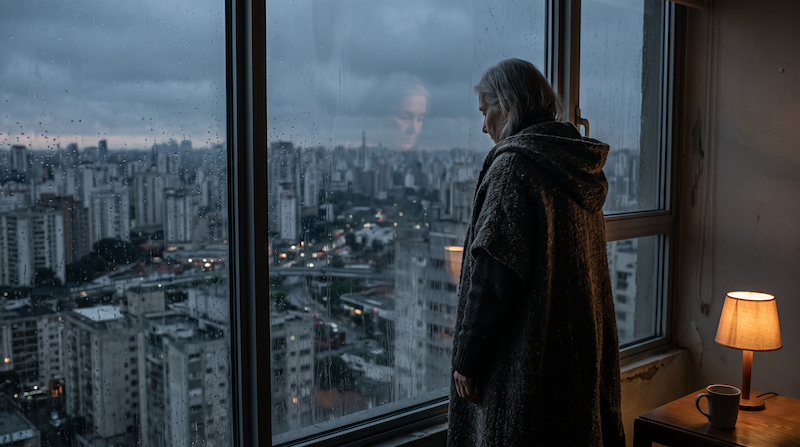
That we looked exhausted. That we owned an incredible amount of things and seemed to enjoy almost none of them. That we lived pressed against thousands of people and knew the names of none of them. That we were loud, sick, always in a hurry, and never once looked up.
The tribe wouldn't be the ones who failed to understand the modern world. They'd be the ones who understood it immediately, and could not believe we'd chosen it.
The Verdict
Drop an uncontacted tribe into New York City and here is what the honest simulation gives you:
- They survive the city easily. Shelter, water, food, navigation, threat assessment — all solved inside 72 hours.
- They do not survive the people. Not the violence — the breathing.
- The legal system has no category for them and never resolves it in time.
- The internet turns them into content within four hours, and the crowd that comes to admire them is the thing that kills them.
- The survivors can never go home, because they'd carry the city back with them.
The thought experiment feels like it's about them. It isn't. Every part of the disaster is generated by us — our viruses, our crowds, our cameras, our paperwork, our appetite.
They'd survive Manhattan.
They just wouldn't survive us.