Why 1 in 4 People Sneeze When They Step Outside

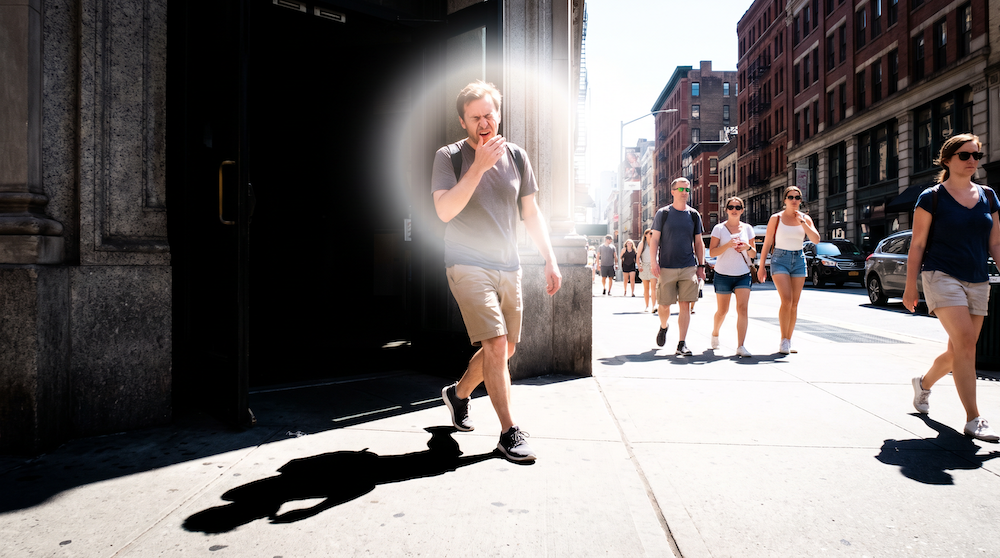
Walk out of a dark cinema into afternoon sun. If you're one of about a quarter of people, you'll sneeze — two or three times, quickly, before your eyes have even adjusted.
If you're the other three-quarters, you have no idea what anyone is talking about, and you probably think they're making it up.
It has a name. It's called the photic sneeze reflex, and — inevitably, because doctors love this sort of thing — it also carries the backronym ACHOO: Autosomal Dominant Compulsive Helio-Ophthalmic Outburst.
And here's the part that should bother you more than it does. It is one of the oldest recorded questions in medicine, and it is still open.
Aristotle asked about it in the Book of Problems, around the fourth century BC. He wondered why the sun makes people sneeze while the heat of a fire doesn't.
He got the answer wrong — he thought the sun's warmth caused sweating inside the nose — but notice what he actually did. He isolated a variable. Heat alone doesn't trigger it; something specific about sunlight does. That's a genuinely sharp observation for 2,300 years ago.
Francis Bacon revisited it in the seventeenth century and improved the experiment. He stepped into sunlight with his eyes closed and didn't sneeze, which ruled out warmth on the face and pointed straight at the eyes.
So we've known where to look since 1635. We still don't know what's happening there.

The leading explanation, and why it's still just an explanation
The theory most people have heard involves the trigeminal nerve — the big cranial nerve that handles sensation in your face, including the inside of your nose.
The optic nerve, carrying the signal that light has hit your retina, runs close to it. The proposed mechanism is crosstalk: a burst of light produces a surge of signal, and some of it bleeds into the trigeminal pathway, which interprets the input the only way it knows how — as irritation in the nose. So you sneeze.
It's plausible. It fits the anatomy. It explains why closing your eyes prevents it.
What it doesn't explain is why only some people do it, why the effect requires a change in light rather than steady brightness, or why a handful of people report the same reflex from things that have nothing to do with light at all — a full stomach, or plucking an eyebrow.
Imaging studies have suggested increased activity in visual and somatosensory areas of the brain in people who have it, which points toward central processing rather than a simple wiring shortcut near the nose. But nobody has closed the case.
That's the honest state of the science: a strong hypothesis, an old question, and no proof.
You didn't catch it, you inherited it
The "autosomal dominant" in that acronym is the part with real consequences.
Dominant inheritance means one copy of the gene is enough. If you have the photic sneeze reflex, one of your parents almost certainly does too — and each of your children has roughly a 50% chance of getting it.
It's one of the very few genetic traits you can test for at a family gathering. Take everyone outside on a bright day and watch who sneezes. You'll usually be able to draw the family tree in about thirty seconds.
Consumer genetics companies have flagged variants associated with it, and it's one of the more reliably reported traits in that space — partly because it's so easy for people to confirm about themselves.

Why anyone bothers studying it
A sneeze in the sun sounds like trivia, and mostly it is. But there are contexts where a sudden involuntary two-second eye closure matters quite a lot.
Fighter pilots emerging from cloud into direct sun. Drivers coming out of a tunnel at speed. There's a reason military aviation medicine has taken an interest in the reflex — a pilot sneezing at the moment of transition is a pilot who isn't looking at anything for a moment.
The proposed fix is almost comically simple: put your sunglasses on before you leave the dark, not after.
My take
What I like about this reflex is that it's a small, permanent embarrassment for the idea that we understand ourselves.
We can sequence a genome in a day. We can image a working brain. And a quarter of the human population does something completely involuntary, in public, several times a summer, and the best available answer is still "two nerves are probably close together."
Aristotle noticed it. Bacon designed a decent experiment for it. Twenty-three centuries later we've added an acronym and some fMRI scans, and the mechanism is still a hypothesis.
I don't find that discouraging. I find it clarifying. The gaps in what we know aren't all at the edges of physics or the bottom of the ocean. Some of them are on your face, firing every time you walk outside.
Try it. Next bright day, step from shade into full sun and pay attention. Then ask your parents. One of them already knows the answer.